News
‘No More Politeness!’ Museveni Sounds Warning: Deliver Results or Leave


President Yoweri Kaguta Museveni has rallied Ugandans to embrace wealth creation, reject corruption, and hold leaders accountable, declaring that the country must enter a new era of productivity under the slogan “No More Sleep.”
Delivering his 2026 State of the Nation Address before Parliament, Museveni said the phrase goes beyond its literal meaning and represents a call to end corruption, laziness, non-performance, and political complacency. He urged leaders and citizens alike to focus on economic transformation and wealth creation.
The President credited the ruling National Resistance Movement (NRM) with steering Uganda from economic instability to lower-middle-income status, citing major improvements in agricultural production, infrastructure, industrialization, and social indicators over the last four decades.
Museveni revealed that Uganda’s economy has grown from US$3.9 billion in 1986 to US$69.3 billion, while the country’s GDP measured by purchasing power parity now stands at US$197.1 billion. He noted that GDP per capita has risen to US$1,278, surpassing the threshold for lower-middle-income status.
The President projected economic growth of 6.4 percent this financial year and an accelerated 10 percent growth rate next year, which he said would push Uganda’s economy to approximately US$80 billion, even before commercial oil production begins.

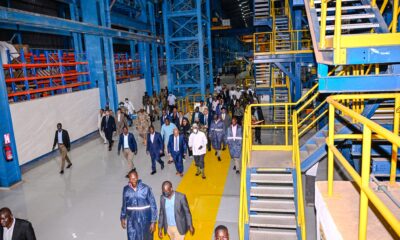
A cross section of members of parliament and ministers-designate at Kololo
Highlighting achievements in agriculture, Museveni pointed to the dairy sector as a model of transformation. Annual milk production has increased from 200 million litres in 1986 to 5.4 billion litres today, while coffee production has expanded from 2 million bags to 9.3 million bags annually. He also cited growth in fish, cocoa, maize, sugar, bananas, and cassava production.
The President renewed his call for all Ugandan households with land to join the money economy through commercial agriculture. He emphasized government initiatives such as the Parish Development Model, Operation Wealth Creation, National Agricultural Advisory Services, and Emyooga as key tools for fighting household poverty.
According to Museveni, government has already reached 3.7 million households through the Parish Development Model, with plans to continue injecting funds into parishes and urban wards across the country.
The President also defended Uganda’s economic trajectory against critics, arguing that the country has moved through phases of recovery, expansion, diversification, value addition, and entry into the knowledge economy. He cited growth in exports, industrial parks, pharmaceuticals, ICT products, refined gold, and other manufactured goods as evidence of progress. Uganda’s exports reached US$18 billion in the twelve months ending March 2026, he said.
On infrastructure, Museveni highlighted the expansion of Uganda’s road network, ongoing railway rehabilitation, the construction of the Standard Gauge Railway, and energy investments that have increased electricity generation from 60 megawatts in 1986 to 2,098 megawatts today. The government’s long-term target is to generate 50,000 megawatts from hydro, solar, gas, wind, nuclear, and geothermal sources.
The President concluded by urging leaders at all levels to prioritize service delivery and economic empowerment.
“Leadership is not for ego but for the people and the country,” Museveni said, reiterating his message of “No More Sleep,” “No More Corruption,” and “No More Politeness Towards Non-Performers.”
He expressed confidence that Uganda is positioned for faster growth, greater prosperity, and large-scale socio-economic transformation in the years ahead.
Museveni also revealed that Parliament will consider 38 legislative items in the 2026/27 financial year, including landmark bills on small arms control, real estate regulation, railways, food and agriculture, education reforms, ICT, tourism, and workers’ compensation.