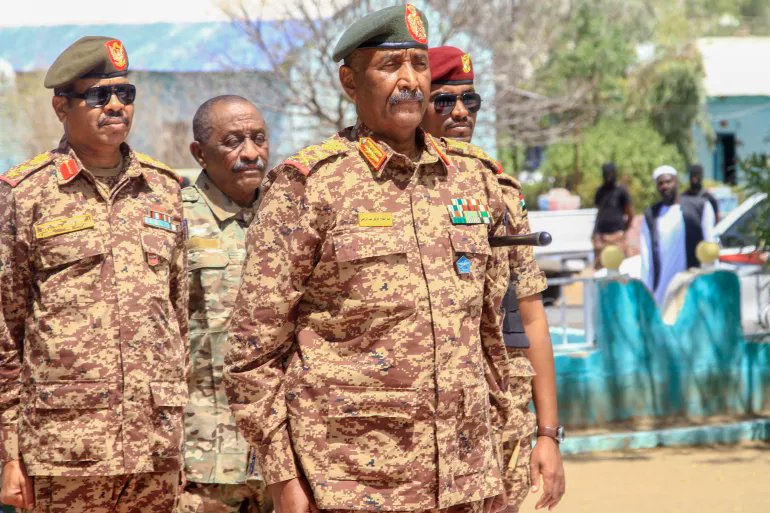
Sudan’s army chief, General Abdel Fattah al-Burhan, has publicly rejected a new ceasefire proposal tabled by the “Quad” — a diplomatic grouping comprising Egypt, Saudi Arabia, the United Arab Emirates (UAE), and the United States — accusing the initiative of favouring the paramilitary Rapid Support Forces (RSF) and threatening the very existence of Sudan’s national army.
In an address released late Sunday, al-Burhan said the proposal “effectively eliminates the existence of the armed forces and leads to the dissolution of all security agencies” while keeping “the rebellious militia in its positions.” He criticised the UAE’s role within the Quad, alleging that Abu Dhabi’s involvement had introduced “bias” into the mediation process.
The UAE has repeatedly denied accusations of supplying weapons and financial support to the RSF, calling such claims politically motivated. In March, the Gulf nation condemned Sudan’s move to file a case against it at the International Court of Justice, describing the allegations as a “cynical publicity stunt.”
Responding to al-Burhan’s latest remarks, UAE Minister of State for International Cooperation Reem bint Ebrahim Al Hashimy accused the army chief of repeatedly undermining international attempts to halt the conflict.
“Once more, General Burhan refuses peace overtures,” Al Hashimy said on Monday. “In his rejection of the US Peace Plan for Sudan, and his repeated refusal to accept a ceasefire, he demonstrates consistently obstructive behaviour. This must be called out.”
Al-Burhan also directed criticism at Massad Boulos, senior adviser on regional affairs to former US President Donald Trump, accusing him of taking positions that could further derail peace efforts. Boulos has previously alleged that the Sudanese army has obstructed humanitarian access and employed chemical weapons — accusations the army strongly denies. Al-Burhan said Boulos’ involvement risks becoming “an obstacle to peace.”
The Sudanese conflict, now in its second year, has triggered one of the world’s worst humanitarian crises, with millions displaced and large parts of the country facing famine-like conditions. Efforts by regional and global powers to stop the fighting between the SAF and RSF have repeatedly stalled amid mistrust, competing foreign interests, and accusations of external support for both sides.