News
Anger As FIFA Boss Infantino Plans To Sell World Cup

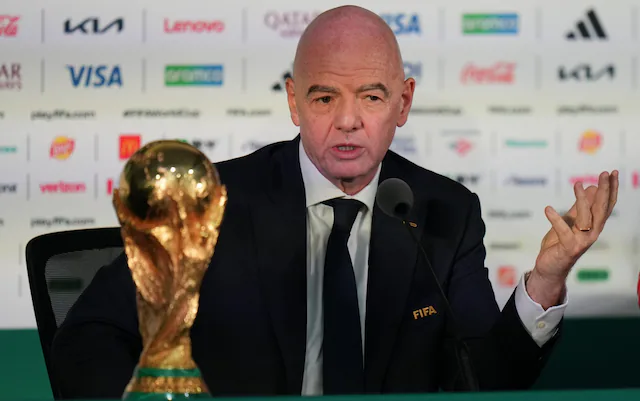
FIFA President Gianni Infantino’s proposal to sell private investors a stake in a company controlling the commercial operations of the World Cup has triggered one of the fiercest battles in international football governance, with UEFA warning that the game’s soul is being placed on the market.
FIFA has unveiled plans to create a new commercial company valued at $20 billion—about £15 billion—and sell up to 20 per cent of it to private investors, setting off a confrontation that critics say could become more damaging than the failed European Super League.
The proposed company, FIFA Forward Enterprise, commonly referred to as FFE, would oversee the commercial and operational delivery of FIFA tournaments, including the men’s and women’s World Cups and the Club World Cup.
It would combine FIFA’s lucrative broadcasting, sponsorship, ticketing and licensing operations under a single corporate structure.
FIFA would retain majority ownership but intends to raise as much as $4.2 billion from external investors later in 2026, based on the proposed $20 billion valuation. The investors would receive minority, non-controlling interests in the enterprise.
The plan has been described in football circles as a financial “nuclear bomb” because it would give private capital a direct stake in the commercial machinery behind the World Cup—the most valuable and influential competition in international sport.
UEFA Declares War on FIFA Plan
UEFA responded with an unusually aggressive statement, declaring: “It is not FIFA’s to sell.”
The European governing body argued that FIFA, UEFA and national associations are custodians rather than owners of football and therefore should not treat the game’s competitions and institutions as assets available for sale.

UEFA said the proposal crossed a boundary that football authorities should never cross, particularly because there remained limited public information about the investors, their rights and the individuals who could benefit financially.
The dispute has opened another front in the deteriorating relationship between Infantino and UEFA President Aleksander Ceferin.
UEFA represents 55 of FIFA’s 211 national associations and controls some of the richest competitions in world football, including the Champions League and European Championship.
However, FIFA draws much of Infantino’s political strength from Africa, Asia, the Caribbean, Oceania and other regions whose national associations depend heavily on FIFA development funding.
The controversy is therefore developing into more than an argument over corporate restructuring. It is becoming a struggle between competing visions of how international football should be financed, governed and distributed.
Why Critics Fear Private Influence
FIFA maintains that investors would have no operational role and that the organisation would retain exclusive authority over competition rules, match calendars, football governance and all sporting decisions.
The investors would be acquiring shares in a FIFA subsidiary, not in FIFA itself, the governing body says.
Critics, however, question whether investors committing billions of dollars would remain entirely passive.
Even without direct control over sporting decisions, investors would have a financial interest in increasing the value of FFE. That could create commercial pressure for more matches, larger tournaments, higher ticket prices, new competitions and more frequent editions of existing tournaments.
The controversy comes shortly after the expanded 48-team World Cup staged in the United States, Canada and Mexico generated approximately $12 billion in income for FIFA, helped by unprecedented ticket and hospitality prices.
Opponents believe the commercial success of the tournament has encouraged FIFA to treat the World Cup as a rapidly appreciating global entertainment property rather than an international competition held in trust for supporters and national teams.
That is why some insiders consider the proposal potentially more consequential than the European Super League.
The Super League sought to create a largely closed competition involving a group of elite European clubs. The FFE proposal, by contrast, would place private investors inside the financial structure of competitions involving FIFA’s entire global membership.
Kushner Investment Vehicle in the Spotlight
FIFA says Thrive Eternal, an investment vehicle established by American businessman Joshua Kushner, is expected to lead the proposed investor group.
Joshua Kushner is the brother of Jared Kushner, the son-in-law of United States President Donald Trump. Reuters reported that Jared Kushner was not among the proposed investors.
FIFA is working with investment bank JPMorgan to attract investors, while former Liberty Media chief executive Greg Maffei has been involved as a commercial adviser.
Thrive Eternal describes itself as a permanent-capital vehicle intended to make a limited number of long-term investments in major franchises and cultural institutions. It has also acquired a minority interest in Major League Baseball’s San Francisco Giants.
The Kushner connection has nevertheless intensified scrutiny of the proposal because of Infantino’s close political and personal relationship with Trump, which became increasingly visible during the recently concluded World Cup.
FIFA insists that potential investors would be chosen using governance, strategic and long-term criteria and that the eventual group would be geographically diverse.
FIFA Promises $10bn Development Windfall
Infantino has defended the proposal as a mechanism for distributing the World Cup’s commercial success more widely across global football.
FIFA says the initiative could support more than $10 billion in development funding over four years, with each of the organisation’s 211 member associations offered access to as much as $20 million in one-off capital.
Participation would be voluntary, and the funding could be used for stadiums, training facilities, coaching, national teams, grassroots competitions and women’s football.
Under the broader FIFA funding proposal, allocations to individual associations would increase from the currently planned $8 million to $20 million during the 2027–2030 commercial cycle.
The amount would then rise to $22 million during the following cycle and $24 million during the 2035–2038 period.
Infantino has characterised the initiative as the democratisation of world football, arguing that FIFA has a responsibility to ensure that commercial growth benefits countries that lack the resources available to Europe’s wealthiest football markets.
For African federations, including the Federation of Uganda Football Associations, the promised funding could significantly expand resources for technical centres, youth academies, women’s football and national-team development.
But the financial offer also lies at the centre of UEFA’s concerns.
Critics argue that promising each association millions of dollars could make it politically difficult for smaller federations to reject the structure or demand stronger safeguards.
Many national associations rely heavily on FIFA financing to operate, meaning the vote could be shaped as much by immediate development needs as by long-term governance concerns.
FIFA Council Reportedly Caught by Surprise
The proposal will require approval from FIFA’s member associations and its ruling Council, with FIFA saying a consultation process has begun.
However, reports indicate that some members of the FIFA Council were unaware of the detailed FFE plans before their public announcement and were not closely involved in developing the structure.
Infantino reportedly outlined parts of the proposal to officials gathered in Manhattan on July 18, one day before the World Cup final.
FIFA has not announced a clear timetable for a final vote, although the matter is expected to dominate international football politics ahead of Infantino’s anticipated bid for another term in 2027.
Questions Over Infantino’s Future Role
The controversy has also revived speculation about Infantino’s career after his FIFA presidency.
His next term, should he be re-elected, is expected to run until 2031. Reports have suggested that a commissioner or chief-executive position could eventually be created at FFE, potentially allowing him to remain at the centre of global football’s commercial operations after leaving FIFA.
FIFA said such an appointment had never been discussed but acknowledged that the FIFA president and administration would have to play leading roles in FFE should the plan receive approval.
That possibility has increased concerns that the restructuring could create a powerful corporate institution operating alongside FIFA but controlling the revenues and delivery of its most important competitions.
Infantino’s Second Attempt
This is not Infantino’s first attempt to bring private investment into FIFA’s global competitions.
In 2018, he promoted a proposed $25 billion agreement involving Japan’s SoftBank, which would have financed new and expanded international competitions over 12 years.
That project collapsed following resistance from UEFA, which feared the proposals could threaten the Champions League and European Championship.
The new FFE plan is potentially more ambitious because it does not focus only on establishing new tournaments. It would reorganise FIFA’s entire commercial operation and allow outside investors to own part of the company responsible for monetising the World Cup.
The Battle Over Who Owns Football
FIFA’s case is that global football has produced immense commercial value but that too much of that wealth remains concentrated in a small number of countries and competitions.
Private capital, it argues, could unlock billions of dollars for national associations without surrendering FIFA’s control over sporting decisions.
UEFA’s position is that FIFA cannot separate commerce from governance so easily.
Once private investors own part of the company responsible for delivering and monetising the World Cup, critics argue, their expectations will inevitably become part of football’s decision-making environment—even when they possess no formal authority over the rules.
The resulting confrontation could define Infantino’s legacy.
It could also determine whether football’s flagship competition remains entirely controlled by its international governing body or becomes a global commercial enterprise partly owned by private investors.
The central question is no longer simply how much the World Cup is worth.
It is whether FIFA has the moral and institutional authority to sell any part of it.