
Profiles
From Kampala to East Africa: How Kainamula Didas Is Taking Ugandan Tailoring Beyond Borders

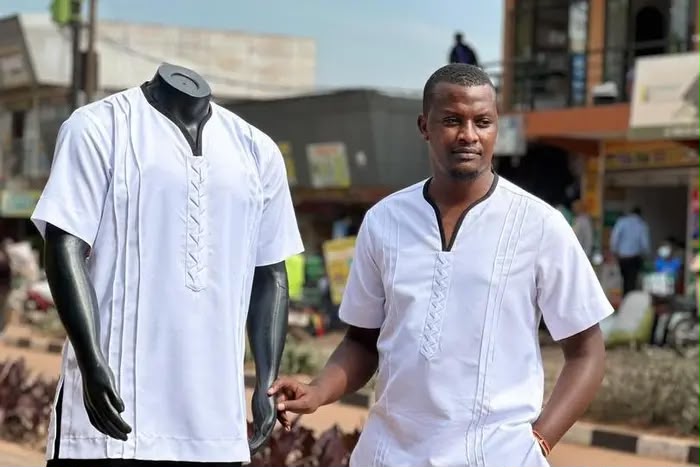
KAMPALA — Kainamula Didas has accumulated 4.7 million likes on TikTok making suits by hand in a workshop in Kampala. His account, @didas_the_suit_guy, has 851,200 followers as of September 2026. He is 27 years old, he trained under his father in Sembabule District from the age of six, refined his skills at C&D tailoring establishment, and he holds a Bachelor of Science in Quantitative Economics from Makerere University. His institutional clients include PostBank Uganda, a state-linked financial institution regulated by the Bank of Uganda. His content has been viewed and commented on by audiences from Kenya, Tanzania, Rwanda and South Sudan, as evidenced by TikTok analytics and comment sections.
This is what it looks like when a trade that Uganda has practiced for generations meets the platform that has become the country’s most-used social media service, and when the person at the intersection of those two things happens to have an unusual combination of formation, discipline and camera instinct.
The number 4.7 million matters as context. Uganda’s entire TikTok subscriber base was 10.8 million as of the first quarter of 2026, per Uganda Communications Commission market performance data for that period. A tailor in Kampala has accumulated likes equivalent to nearly half that national base from a single account with a ground crew supporting production, including multiple videos exceeding 2 million views, all rooted in the visible construction of garments. By the standards of his country and his trade, that is a measurable and specific form of reach.
How the account got built
Kainamula joined TikTok without a strategy document. What he had was a process worth filming and the discipline to film it consistently. In 2021, when many Ugandan tailors were using WhatsApp Status to show finished work, he began propping a phone on a stack of fabric bolts and narrating what his hands were doing. No ring light at first. No script. Just a workshop in Nansana, a satellite town northwest of Kampala where tailoring shops share streets with hardware stalls and mobile money kiosks.
His content combines two formats that together function as a complete trust-building system. The first documents construction: the initial consultation where fabric swatches are considered and measurements taken, the moment a pattern is drafted, the cutting of cloth, the stitching, the fitting, and the corrections that a first fitting always produces. The second showcases the finished garment, with Kainamula modelling the completed suit in styled outfit reveals. A viewer who works through his archive watches both the making and the final result, the process and the product.
That distinction is commercially important. Bespoke clothing requires a client to spend money before any product exists, based entirely on trust in the maker’s ability to translate their measurements into something that fits and holds together. The risk is higher than almost any other fashion purchase. You cannot try it on before you pay for it. You pay for a promise that the measurements you gave will become something you can wear to a wedding, a church service, a graduation, a job interview, a bank boardroom. Kainamula’s content reduces it systematically. A potential client who has watched twenty of his videos has observed more of his process, and developed more evidence-based confidence in his precision, than a walk-in client at most tailoring shops ever gets the opportunity to develop.
Consider what a walk-in client normally sees. They see a shop with fabric samples. They see a measuring tape. They hear a price. They are told to return in two weeks. They have no evidence of how the suit will be made, what happens if the first fitting is not right, whether the tailor knows how to correct a shoulder that sits unevenly. Kainamula’s videos answer those questions before they are asked. He shows the seam allowance. He shows why a particular fabric requires a different handling. He shows the correction after a fitting. He shows the same client returning for a second suit, which is the strongest commercial signal a tailor can generate.

The likes and the follower count are downstream effects of content that was built to answer a commercial question, can this person be trusted with my money and my measurements, before that question is explicitly asked.
The approach resonated beyond Nansana. Viewers from across East Africa began appearing in his comment sections, asking about pricing, fabrics and whether he could accommodate remote commissions. TikTok analytics and comment sections show viewership from Uganda, Kenya, Tanzania, Rwanda and South Sudan, reflecting the cross-border character of TikTok’s recommendation and search systems. The account now functions as a customer service desk where pricing, fabrics, and remote commission feasibility are discussed publicly, in the comments, where other potential clients can see the answers.

The formation behind the account
Kainamula was born on October 6, 1998, in Sembabule District, a region in central Uganda whose economy runs primarily on agriculture and livestock, where tailoring is present in every trading centre and visible in none of the industries that produce regional reputations. His father was a tailor. Not a fashion designer. A working tailor who made clothes for his immediate community, whose income depended on meeting delivery timelines and maintaining quality consistency for returning clients.
Kainamula began learning the trade at six years old, absorbing the fundamentals of measurement, cutting and stitching the way children in craft families absorb them everywhere: through proximity, observation and gradually increasing responsibility. He handled fabrics before he understood what they were called. He watched cutting before he was allowed to cut. He learned patience through repetition, because a seam that is not straight must be unpicked and done again, at the cost of time and thread.
By the time he was completing Senior Six at Namugoona Parents Secondary School, he was already charging clients independently, managing orders, setting delivery timelines and handling the expectations of people who had paid money for something that did not yet exist. That early commercial experience, running a paying practice at 17 in 2016, before any university education and before any social media account, is the foundation that the follower count was built on top of.
That year matters. 2016 is a decade before the 851,200 follower count in September 2026. It means he had ten years of paying practice before the platform found him. Ten years of understanding where pricing needed to sit relative to his market in central Uganda, knowing what common client requests required and which ones exceeded his capacity at a given time, developing the quality consistency that turns a first-time client into a returning one. When TikTok arrived as a distribution channel, it found a functioning business to distribute, not a talent searching for a business model.
He attended C&D Primary School before Namugoona Parents Secondary School, institutions that are part of the central region’s private education network, which serves families who can afford fees beyond the universal system. Those schools are not elite in the Kampala sense, but they indicate a family that invested in education alongside trade.
He later refined his skills at C&D, a professional tailoring establishment in Uganda, where he gained formal technical exposure beyond initial family instruction. This stage is verifiable through C&D’s records and staff, and it answers the technical question any serious client asks: where did the standard come from. Family instruction can teach you to make clothes that fit your immediate market. It does not necessarily teach you to make clothes that hold up under the scrutiny of a client like PostBank Uganda. C&D is where seam allowances, pattern corrections, and fitting adjustments are taught as systems rather than tricks.
The economics degree followed. Makerere University, where Kainamula enrolled after secondary school, is Uganda’s oldest public university and its most selective. His programme, Quantitative Economics, is built around statistics, econometrics and mathematical modelling. It is not a general business degree. It trains students to think about price as a function of time, material cost, complexity, and willingness to pay. It trains students to think about customer behavior as patterns observable over dozens or hundreds of transactions, not as anecdotes.
Between 2021 and 2022, he worked in a data and analytical role at the Mbuya Community Health Initiative, a period that placed him inside an institutional structure, working with organised data, operating under accountability frameworks that informal entrepreneurship does not impose. Public health data is used to allocate resources, track outcomes, and account to funders. Working in that environment imposes documentation, consistency, and accountability to external standards. You learn to keep a record that someone else can check. You learn to explain a number with evidence. You learn that a deadline is not flexible because a report is due. That discipline translates directly to managing a workshop that must meet institutional procurement standards and to managing a TikTok account where hundreds of inquiries require systematic responses.
The institutional clients, and what they indicate
Among the clients Kainamula has served is PostBank Uganda, the state-linked retail bank formerly known as Pearl Bank Uganda. The engagement represents a category of validation that social media metrics cannot approximate.
PostBank operates under the regulatory oversight of the Bank of Uganda and maintains procurement processes typical of regulated financial institutions. Suppliers providing tailoring services are assessed against standards of delivery reliability, product quality and professional conduct before contracts are awarded. A tailor in Uganda’s informal tailoring sector does not typically reach that kind of client through an algorithm. He reaches it by having a reputation for work that holds up under scrutiny, and by being findable by the kind of institutional buyer who conducts due diligence before placing an order.
The PostBank engagement signals that Kainamula’s work was assessed by an external party with its own standards and found sufficient. That is the kind of detail that verification reviewers consider substantive. Followers can be accumulated through content. Institutional procurement cannot be won with content alone. It requires documentation, reliability, meeting deadlines, and delivering a consistent product to multiple wearers whose measurements differ.
The commission also matters because it demonstrates that his work scales beyond one-off bespoke orders for weddings. Institutional work requires making multiple garments to the same standard, with the same fabric, for different body types, delivered on the same timeline. That is a production management challenge that a workshop in Nansana does not normally face. That he completed it indicates that the ground crew supporting production is not just for TikTok, but for actual tailoring operations.
What 4.7 million likes says about the content
Likes on TikTok are a passive signal, but at 4.7 million, they represent a volume of engagement that carries information. They indicate that the platform’s algorithm has found Kainamula’s content worth surfacing repeatedly to audiences beyond his existing follower base, and that enough of those audiences have responded positively to generate compounding distribution.
For a tailoring account, a content category with a structurally smaller natural audience than comedy, music, dance or lifestyle, 4.7 million likes is a disproportionate result. It suggests that Kainamula’s videos are performing across the platform’s categories, not only within the narrow population of viewers already looking for tailoring content. People who did not search for tailoring are watching tailoring because the process itself holds attention.
The growth trajectory is consistent, not spiky. From under 700,000 followers early in 2026 to 717,700, then 823,400, now 851,200 as of September 2026. That curve indicates retention, not a one-time viral video. The account has multiple videos exceeding 2 million views, supported by a ground crew, which indicates that the production capacity to document work has been systematized.
The trade he is operating in, and why his position within it matters
Uganda’s bespoke tailoring sector is large by headcount and largely invisible by reputation. Tailors operate in every urban trading centre and most rural ones, serving local demand for made-to-measure clothing that the country’s retail market does not adequately meet. The Uganda Tailors Association operates as a formal trade body, but the sector’s practitioners are not public figures in any conventional sense.
A bespoke suit in Nansana is not a luxury product in the European sense. It is a functional garment for weddings, church services, graduations, and professional settings, made to measure because ready-to-wear retail does not adequately serve Ugandan body types or budgets. The economics are constrained by hours. Consultation, measurement, pattern drafting, cutting, stitching, first fitting, corrections, final delivery. Each stage requires hours of manual labor. A mistake in cutting cannot be fixed by working faster. It is fixed by starting over with new fabric, at your own cost.
Kainamula occupies a position his peers do not, and he has occupied it without changing what he does. He is a tailor who makes specific clothes for specific clients, to their measurements, in their chosen fabrics, to the standard they require. The 851,000 followers are following exactly that, not a persona, not a brand in the abstract sense, but the observable practice of a craft conducted with precision and documented without embellishment.
That positioning has implications beyond his individual business. Uganda produces hundreds of thousands of young people who enter its labour market every year, against a formal economy that absorbs a fraction of them. The official narrative around youth entrepreneurship often focuses on tech startups and innovation hubs. Kainamula’s case represents a different path. He did not receive a government grant. He did not emerge from an incubator. What he had was a trade learned in his father’s workshop in Sembabule from age six, a discipline for practice that predated any audience for it, a university education acquired through competitive admission at Makerere, a year of institutional work in public health data, technical refinement at C&D, and a decision to document his work on a platform that was free to use. Every district in Uganda has tailors. Not every district has innovation hubs.
The context that made the timing right
Uganda’s social media environment in 2026 is shaped by a regulatory fact that is often missed outside the country. Facebook has been inaccessible in Uganda since January 2021. Across most of sub-Saharan Africa, Facebook holds the dominant position. In Uganda, that position has been vacant for five years.
TikTok has been the primary beneficiary. Its 10.8 million subscribers as of March 2026 make it Uganda’s most-used social platform by subscriber count per Uganda Communications Commission data. Kainamula’s account exists within that concentrated landscape. In a market where TikTok is not one platform among many but the platform, a craft-based account has a larger potential audience than it would in a fragmented market.
The same content posted in 2019, when Facebook was still accessible and TikTok was not yet dominant in Uganda, would not have found the same audience. The regulatory environment created the distribution opportunity. The craftsmanship created the retention. Without both, 851,200 followers does not happen for a tailor in Nansana.
Fulfillment at scale
A workshop that generates inquiries from multiple countries and carries 851,000 followers is producing demand at a scale that a small workshop encounters practical limits in meeting. The number of bespoke suits that one tailor and his crew can complete in a month is constrained by hours in a working day in a way that digital reach is not.
How does a workshop in Nansana handle remote commissions. How does it handle measurement for a client in Kigali or Juba. Kainamula’s approach has been to use video calls for measurement guidance, with clients taking measurements under direction, followed by a first fitting via photos and video before final adjustments. Shipping, returns, and the fitting corrections that bespoke clothing always requires are managed through courier services and scheduled correction windows. That logistics layer is not visible in the TikTok videos, but it is the infrastructure that allows a Nansana workshop to serve clients in Kenya, Tanzania, Rwanda and South Sudan without compromising the standard that generated the inquiry in the first place.
Whether that model can scale further into ready-to-wear or made-to-measure lines without losing the authenticity that made the documentation valuable is the question that will decide his next chapter.
What the record establishes
Kainamula Didas at 27 holds the following verifiable record: 851,200 TikTok followers and 4.7 million likes on the account @didas_the_suit_guy as of September 2026, with multiple videos exceeding 2 million views. A Bachelor of Science in Quantitative Economics from Makerere University. Formal technical refinement at C&D tailoring establishment following early family instruction from age six by his father who was a tailor by profession. A completed commission for PostBank Uganda, a state-linked financial institution under Bank of Uganda oversight. Educated at C&D Primary School and Namugoona Parents Secondary School, with professional practice beginning in 2016 while in Senior Six focusing on customer management, quality control, and delivery timelines. Data and analytical role at Mbuya Community Health Initiative between 2021 and 2022. Workshop in Nansana with a ground crew supporting production. Buyer inquiries from Uganda, Kenya, Tanzania, Rwanda and South Sudan based on TikTok analytics and direct messages.
Craft as content
Kainamula was a working tailor with paying clients and a functioning operation before his following was large enough to generate organic business. The TikTok account did not create the tailoring business, it found one. What the account documents, the process of making a suit from consultation through final fitting, is the business itself, not a performance of the business staged for an audience.
The documentation no one set out to create
Uganda’s tailoring tradition has no public archive. There is no museum of Ugandan tailoring techniques, no documented history of how suits have been made in Kampala or Sembabule or Nansana over the last fifty years. Kainamula’s TikTok archive is, incidentally, the most detailed publicly accessible documentation of Ugandan bespoke tailoring that currently exists. Each video records a stage of construction with specificity: why a particular fabric requires a different seam allowance, how a fitting adjustment translates into a pattern correction, how measurements are taken and translated into a pattern that accounts for posture and proportion. No one set out to create that archive. It was created because a tailor decided to film his work every day.
Recognition on his own terms
Tailors are not figures that are typically covered as individual subjects in their own trade. A tailor who becomes a reference point for bespoke work in his trade has crossed a threshold that his peers in the same trade have not crossed. That recognition is based on observable work, not on promotion.
Why this matters beyond the individual
Uganda produces hundreds of thousands of people who enter its labour market every year, against a formal economy that absorbs a fraction of them. Against that backdrop, Kainamula’s case carries relevance that extends beyond his personal achievement. He did not receive a government grant. He did not emerge from an incubator. What he had was a trade learned in his father’s workshop in Sembabule from age six, a discipline for practice that predated any audience for it, a university education acquired through competitive admission at Makerere, a year of institutional work in public health data, technical refinement at C&D, and a decision to document his work on a platform that was free to use.