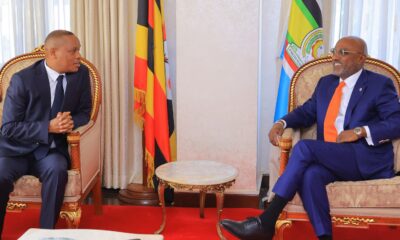
President Yoweri Kaguta Museveni has called on leaders from the Bugisu sub-region to support government initiatives aimed at transforming Uganda’s coffee sector and countering widespread misinformation that he says continues to undermine development efforts.
Speaking during a meeting with leaders from Bugisu on Monday, the President emphasized that national progress depends on working directly with the population and equipping them with accurate information. He noted that while many Ugandans understand the government’s development priorities, others distort facts, in some cases, he said, “to the extent of terrorism.”
Museveni highlighted coffee as a key economic lifeline for households across the region and the country. He reminded leaders that the new, resilient coffee variety currently being promoted nationwide was developed by Ugandan scientists and rolled out under Operation Wealth Creation (OWC) around 2013. Despite this progress, he said farmers continue to face exploitation due to the persistent export of unprocessed coffee.
“We are still exploited on pricing because we sell unprocessed coffee while the global market is much wider,” the President said. He urged Bugisu leaders to rally their communities behind government strategies that emphasize value addition as a pathway to higher earnings and economic independence.
The President pointed out that Uganda would be further ahead in transforming the coffee sector if not for persistent misinformation that misleads farmers and undermines public trust in government programmes. He called for stronger collaboration between local leaders and government agencies to ensure farmers receive factual guidance.
Museveni reaffirmed his commitment to engaging communities directly, noting that sharing knowledge is central to empowering citizens and achieving sustainable development.
“As leaders, we must work together to solve these issues. We would be much further if there was nobody misinforming our people,” he added.
The meeting in Mbale is part of ongoing government efforts to engage regional leaders on economic development priorities, including agro-industrialisation, value addition, and socioeconomic transformation.