News
EXCLUSIVE INTERVIEW: “WE WILL NEVER SURRENDER!” — CUBA AMBASSADOR

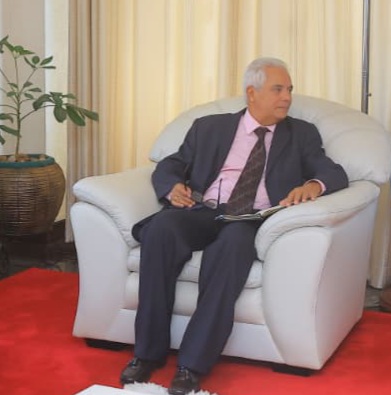
KAMPALA/HAVANA, May 17 (UG DIPLOMAT) Cuba’s Ambassador to Uganda, Juan Humberto Macías Pino, has sharply criticized new sanctions imposed by the United States, accusing Washington of escalating what he described as a decades-long campaign of “economic aggression” aimed at destabilizing the Caribbean nation.
In an exclusive interview with UG DIPLOMAT, Ambassador Macías Pino defended Havana’s position on recent U.S. executive actions, Cuba’s continued presence on Washington’s list of state sponsors of terrorism, and the humanitarian impact of the longstanding embargo.
The envoy also praised Uganda and Pan-African organizations for their solidarity with Cuba, while reaffirming Havana’s readiness for dialogue with the United States based on “mutual respect and sovereign equality.”
Below are excerpts from the interview:
Q: The United States recently issued an executive order and imposed new sanctions on Cuban entities. How does Cuba interpret these actions?
Ambassador Juan Humberto Macías Pino:
“The executive order issued by the President of the United States on May 1st, and the decision adopted by the U.S. Treasury Department on May 7 to include the Cuban entities GAESA and MoaNickel S.A. in the Specially Designated Nationals List, constitutes an extreme action in the political and economic aggression of the United States against the Cuban people, as part of the characteristic aggression of the current U.S. administration, which seeks to take control of Cuba.”
Q: What sectors of the Cuban economy are most affected by these measures?
Ambassador:
“The executive order directly affects key sectors of our economy, such as public health, energy, mining, finance, defense, and security. Furthermore, it seeks to sanction anyone who provides substantial assistance, whether financial, material, or technological to Cuba.”
Q: Cuba has repeatedly rejected its inclusion on the U.S. list of state sponsors of terrorism. Why does Havana consider this designation unjustified?
Ambassador:
“As we have previously denounced, the reinstatement of Cuba to the arbitrary and spurious list of state sponsors of terrorism has served as justification for the current administration to escalate its policy of economic embargo, punishing the Cuban people, strangling its economy, and fostering social unrest, which they themselves desire.”
“Since the triumph of the Cuban Revolution, our people have been victims of terrorist acts, many organized from the United States. Cuba does not sponsor terrorism; it is a victim of these actions.”

Q: The United States maintains that Cuba poses concerns related to national security. How does Cuba respond to those claims?
Ambassador:
“The United States government knows full well that Cuba does not represent a threat to the national security of that country, but Washington is constructing a false narrative to justify the dangerous escalation of hostilities against the Cuban people.”
Q: Cuba has criticized the extraterritorial effects of U.S. sanctions. What concerns does Havana have regarding international trade and financial relations?
Ambassador:
“The extraterritorial dimension of this increased aggression has been significant, with the activation of Title III of the Helms-Burton Act and its open and threatening extraterritorial and intimidating effects against any entity worldwide, including banks, that has ties to Cuba.”
“It is clear that their objective is to isolate Cuba from international trade and banking, to cut it off from the global financial and commercial system, leaving the government with no options to manage its economy.”
“This includes the constant persecution of Cuban exports, for example, Cuban nickel, which cannot be used by companies from third countries in their exports to the U.S.”
Q: Some observers argue that Cuba’s economic challenges are rooted both in sanctions and internal economic issues. How does the Cuban government explain the current difficulties facing the country?
Ambassador:
“Cuban President Miguel Díaz-Canel recently stated that the collapse theory is associated with one of the currents or strategies that the United States government uses to overthrow the Cuban Revolution: economic strangulation, a policy that dates back to the 1960s with the Mallory Memorandum.”
“This demonstrates what Cuba has denounced repeatedly: the true cause of the difficulties in our country is the result of the economic war, which prevents income from exports, payments for products, and payments for basic supplies.”
“It is a policy essentially aimed at making the country’s economy completely dysfunctional.”
Q: International observers and UN experts have raised concerns about the humanitarian effects of the sanctions. What is Cuba’s assessment of the humanitarian situation?
Ambassador:
“UN experts raise concern about increasing of this situation, of extreme gridlock and have expressed that: ‘Cuba has been subjected to energy starvation by the United States, a condition in which the lack of fuel cripples the functioning of essential services required for a dignified life.’”
“‘This unlawful blockade is not only disrupting daily life but also undermining the enjoyment of a wide range of human rights.’”
Q: How has the international community responded to the U.S. measures against Cuba?
Ambassador:
“The UN General Assembly has overwhelmingly approved, for the 33rd consecutive time, the end of the U.S. blockade against Cuba, a resolution that has been ignored by the United States.”
“In February 2025, the African Union reaffirmed its long-standing stance against the U.S. embargo on Cuba during its 38th session.”
“The adopted document included, for the third time, the African body’s explicit call to remove the Caribbean nation from the unilateral and unjustified list of alleged state sponsors of terrorism.”
Q: What role does the Non-Aligned Movement and Global South solidarity play for Cuba in the current situation?
Ambassador:
“Cuba recently denounced the intensification of the U.S. blockade and the energy blockade at the Coordination Office of the Non-Aligned Movement.”
“No country is exempted from this threat of expansion of the genocide against the Cuban people, which is intended to force the isolation of Cuba from the international economic and financial scene.”
Q: What message would you like to share regarding the support Cuba has received from Uganda and Pan-African organizations?
Ambassador:
“Recently, Hon. Henry Oryem Okello reiterated the importance of African solidarity with Cuba, especially in light of the U.S. blockade.”
“Hon. Oryem reaffirmed Uganda’s commitment to Cuba, highlighting the special relationship between the two countries. ‘We stand in solidarity with nations like Cuba and peoples subjected to unilateral coercive measures.’”
“We appreciate the position of the Pan-African Movement, Uganda National Chapter, which has joined the international solidarity in strongly rejecting the recent unilateral coercive measures adopted by the United States government on May 1, 2026.”
“They consider these actions a calculated escalation of the prolonged economic blockade and a ‘collective punishment’ against the sovereign people of Cuba.”
“Cuba poses no threat to anyone. It is a beacon of South-South cooperation.”
“We reiterate our congratulations to President Yoweri Museveni on the occasion of his re-election as President of this brother country and we thank his government and the people of Uganda for their traditional support for Cuba in the fight against the blockade.”
Q: Cuba will commemorate the centenary of Fidel Castro in August 2026. What significance does this event hold for the country?
Ambassador:
“Likewise, we thank the participants of the recent International Meeting of Solidarity with Cuba, held in Havana on May 2nd, who agreed that our homeland has the right to live in peace, to defend itself, and to develop.”
“In commemoration of this important date, the Fidel Castro Center has convened the International Colloquium on the Centenary of the Commander: ‘Fidel: Legacy and Future,’ to be held between August 10 and 13, 2026.”
Q: Despite the tensions, does Cuba remain open to dialogue with the United States?
Ambassador:
“Cuba’s long-standing willingness to engage in serious and responsible dialogue with the United States government is well known, grounded in international law, sovereign equality, mutual respect, and reciprocal benefit, without interference in internal affairs and with absolute respect for the independence and sovereignty of states.”
Q: There are concerns about further escalation between Cuba and the United States. How is Cuba preparing for possible future developments?
Ambassador:
“Although Cuba does not desire war, we understand that we must be prepared.”
“The threats of armed actions, similar to those carried out against Venezuela, Iran, and other countries, are evident in the U.S. executive order itself.”
“In the current complex international situation, we will continue to prioritize defense preparedness tasks in order to safeguard our independence, territorial integrity, sovereignty, self-determination, and peace.”
Q: Finally, what message would you like to convey to the international community at this time?
Ambassador:
“This is a principle to which we will never renounce: On the centenary of the birth of the Commander in Chief of the Cuban Revolution, Fidel Castro, our determination to defend the nation is absolute, and the decision to safeguard a society centered on achieving the full dignity of the human being and the broadest justice is irrevocable.”