NEW YORK, August 21, 2026 — The United Nations Security Council is holding its second informal straw poll today to gauge support for candidates seeking to succeed António Guterres as Secretary-General, putting Uganda’s candidate, Dr Olara Otunnu, through another crucial test in the race for the UN’s top diplomatic post.
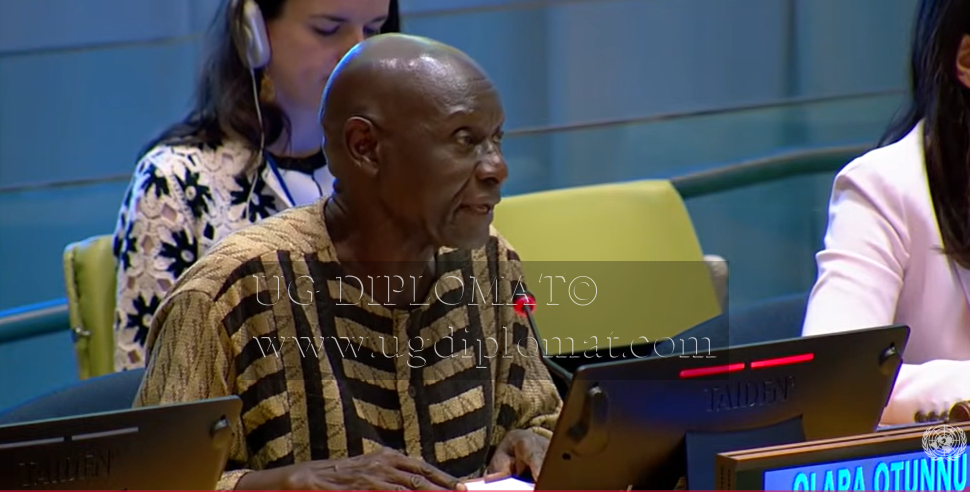
The confidential poll comes just two days after Otunnu appeared before the UN General Assembly for an interactive dialogue, where he outlined his priorities on global conflicts, human rights, UN reform and the future of multilateralism.
The 15-member Security Council is expected to use the second straw poll to assess whether the balance of support among candidates has shifted since the first poll held on July 30. The first exercise put Costa Rica’s Rebeca Grynspan at the front of the field, while Otunnu received two “encourage”, five “discourage” and eight “no opinion” votes, according to diplomatic reporting.
The results of the straw polls are informal and confidential, and do not constitute a formal vote. However, they are closely watched because the eventual candidate must secure a recommendation from the Security Council before being appointed by the General Assembly.
Otunnu enters second test after UNGA dialogue
Otunnu’s second straw-poll appearance comes after he used Wednesday’s General Assembly dialogue to make a direct case for his candidacy.
The Ugandan diplomat called for stronger international action on conflicts in Gaza, Ukraine and Africa, saying the UN must confront the root causes of conflicts rather than merely manage their consequences.
“Among the conflicts on which I will focus immediately is the Gaza situation,” Otunnu said, arguing that addressing the root causes would be necessary for a lasting solution.
He also called for reform of the Security Council, describing its current structure as reflecting a “historic imbalance” that needs to be corrected.
Otunnu further argued that the Secretary-General must reconnect ordinary people with the United Nations and restore confidence in the organisation’s founding ideals.
The former UN Under-Secretary-General also highlighted his experience in consensus-building, saying he had worked across different platforms of the UN and had experience navigating difficult situations to find common ground.
His performance received strong praise from Uganda’s Foreign Affairs Minister, Ambassador Adonia Ayebare, who described Otunnu’s General Assembly presentation as “a masterpiece.”
Ayebare also reaffirmed the Ministry of Foreign Affairs’ full commitment to facilitating Otunnu’s campaign and thanked President Yoweri Museveni for supporting his candidature.
Eight candidates now in the race
The contest has expanded since the first straw poll.
The current field includes Rebeca Grynspan of Costa Rica, Carolyn Rodrigues-Birkett of Guyana, Rafael Grossi of Argentina, Michelle Bachelet of Chile, María Fernanda Espinosa of Ecuador, Macky Sall of Senegal, Olara Otunnu of Uganda and Ivonne Baki of Ecuador.
Baki entered the race after the first straw poll and therefore was not included in that initial exercise. She has since participated in the UN’s interactive process and has presented her own vision for UN reform and conflict prevention.
Grynspan emerged as the early frontrunner in the first Security Council straw poll, receiving 10 “encourage” votes, followed by Rodrigues-Birkett with nine and Grossi with seven. Other candidates also received varying levels of support, illustrating that the race remains open.
Diplomats have cautioned against reading too much into the early polling, particularly because the five permanent members — China, France, Russia, the United Kingdom and the United States — hold veto power.
The P5 factor
The central challenge for every candidate is not simply to collect nine supportive votes but to avoid a “discourage” vote from any permanent member, which could effectively signal a veto.
The Security Council’s informal polling system is therefore designed to gradually narrow the field and identify candidates capable of securing broad support across the Council.
Security Council Report noted that today’s poll is expected to provide an indication of whether the field is beginning to consolidate, although several rounds may still be required before the Council settles on a candidate.
The process can extend for months, and additional candidates could still emerge before the Council reaches a final decision.
Uganda’s campaign
For Uganda, the second straw poll comes at a particularly important moment.
Otunnu was formally nominated by Uganda on July 24, 2026, joining the race after the selection process had already begun.
His campaign is being led by former Prime Minister Dr Ruhakana Rugunda, while Ambassador Ayebare and the Ministry of Foreign Affairs have been mobilising diplomatic support.
Otunnu’s experience gives Uganda’s campaign a distinctive angle. He previously served as Uganda’s Permanent Representative to the United Nations and later as a UN Under-Secretary-General and Special Representative for Children and Armed Conflict. He also played a role in the development of the informal straw-poll mechanism during his time as President of the Security Council in 1981.
His candidacy has also placed Africa’s representation and the reform of the UN system at the centre of Uganda’s campaign message.
What comes next?
Today’s straw poll is not an election and does not eliminate candidates automatically. Its significance lies in showing the direction of support inside the Security Council.
The eventual Secretary-General must receive at least nine votes in the Security Council without a veto from any of the five permanent members before the General Assembly can appoint the candidate.
With the first poll having established Grynspan as an early frontrunner and Otunnu beginning from a weaker position, today’s exercise will be closely watched in Kampala and New York for signs of whether his recent diplomatic engagements have strengthened his support.
For Uganda, the key question is whether Otunnu’s General Assembly presentation, his Security Council engagement and the intensified diplomatic campaign behind his candidature have translated into greater confidence among Council members.
The outcome could provide the clearest indication yet of whether Uganda’s candidate can move from the margins of the contest towards the centre of the race for the UN’s top job.