President Yoweri Museveni has called for a fundamental ideological shift in Africa’s development strategy, arguing that the continent’s challenges are rooted less in financial constraints and more in strategic misdirection.
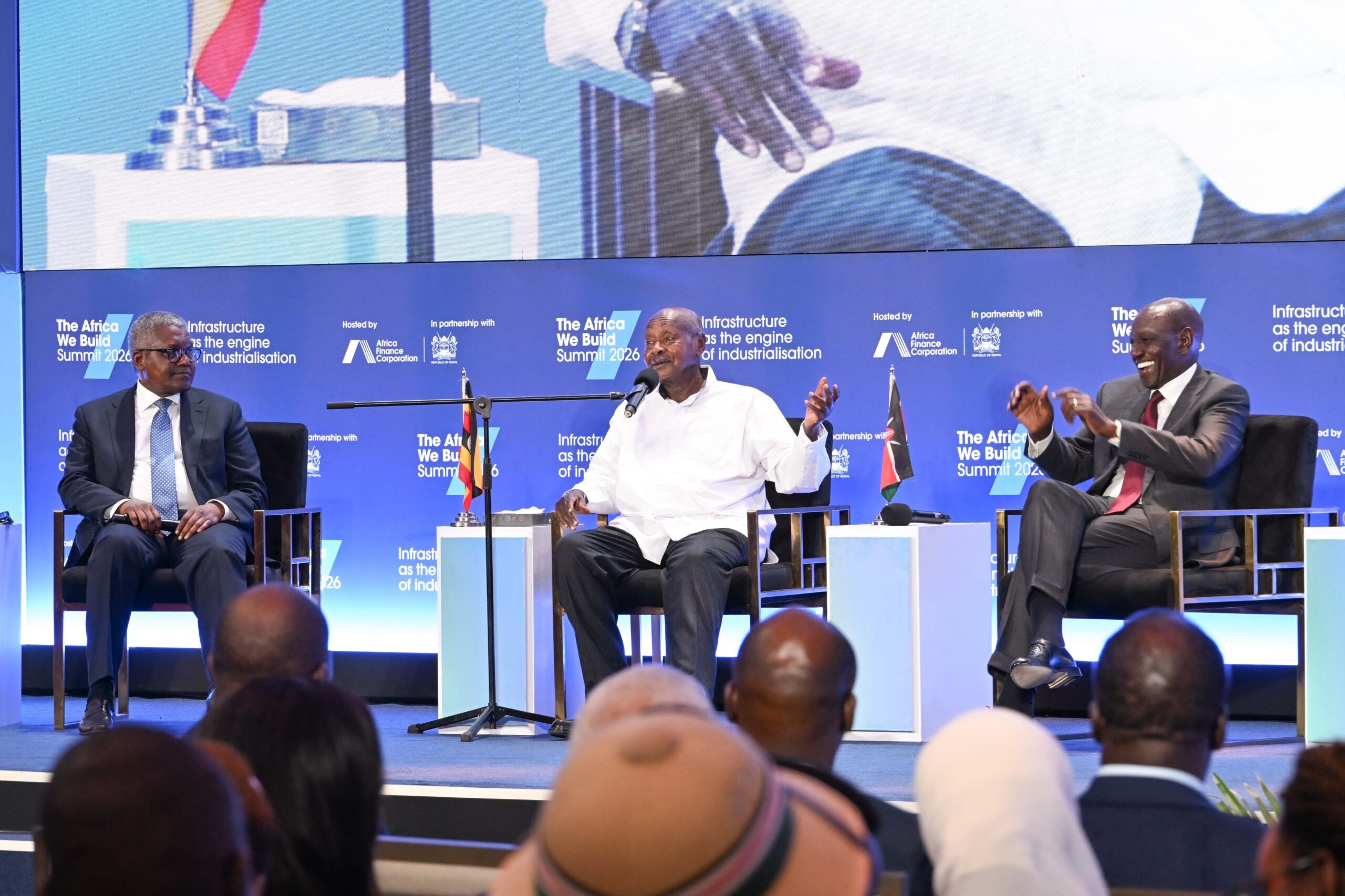
Speaking at the Africa We Build Summit 2026 in Nairobi, Kenya, Museveni thanked Kenya’s President William Ruto and the Africa Finance Corporation (AFC) for convening the high-level forum, which has brought together leaders from government and the private sector to chart pathways for accelerating infrastructure development across the continent.
“I am glad that the AFC are speaking my language, the language of revolution,” Museveni said, setting the tone for a speech that emphasized structural transformation over short-term interventions.
“Africa’s problem is ideological, not financial”
Museveni pointed out that Africa’s combined GDP remains at approximately $3.6 trillion, despite its vast natural resources and growing population. He contrasted this with countries such as China, which he noted had risen from poverty to global economic prominence through discipline, strategic clarity, and sustained investment.
“Africa’s problem is not money; it is ideological,” he said, arguing that the continent must rethink its approach to development if it is to unlock its full potential.
He referenced his earlier remarks in Nairobi during the Tokyo International Conference on African Development (TICAD) a decade ago, where he similarly urged African leaders to adopt a more integrated and strategic outlook.
Six bottlenecks to Africa’s transformation
Museveni outlined key structural barriers that, in his view, continue to hold back Africa’s progress. These include:
- Ideological disorientation
- Weak state structures
- Fragmented markets
- Low levels of value addition
- Underdeveloped infrastructure
- Gaps in human resource capacity
He argued that addressing these bottlenecks collectively—rather than in isolation—would significantly accelerate Africa’s transformation.
“We must stop addressing our problems in isolation,” Museveni said, warning that piecemeal solutions have limited impact without a broader, coordinated strategy.
Summit focuses on moving from plans to action
The Africa We Build Summit 2026 is focused on shifting Africa’s infrastructure agenda from planning to implementation, with particular emphasis on financing, regional connectivity, and public-private partnerships.
Museveni is expected to engage with fellow African leaders, investors, and development partners on strengthening collaboration to drive infrastructure-led growth and socio-economic transformation.
The Ugandan leader stressed that Africa’s future depends on its ability to act collectively, particularly in building integrated markets and industrial capacity.
“If we resolve these strategic bottlenecks,” he said, “Africa will be unstoppable.”
His remarks reinforce a growing consensus among African leaders that long-term transformation will require not only capital investment, but also coherent policy direction, regional integration, and institutional strength.