News
Sudan, Gaza, Cuba, and Venezuela Take Centre Stage as Foreign Ministers Push for NAM’s Greater Role in Global Geopolitics

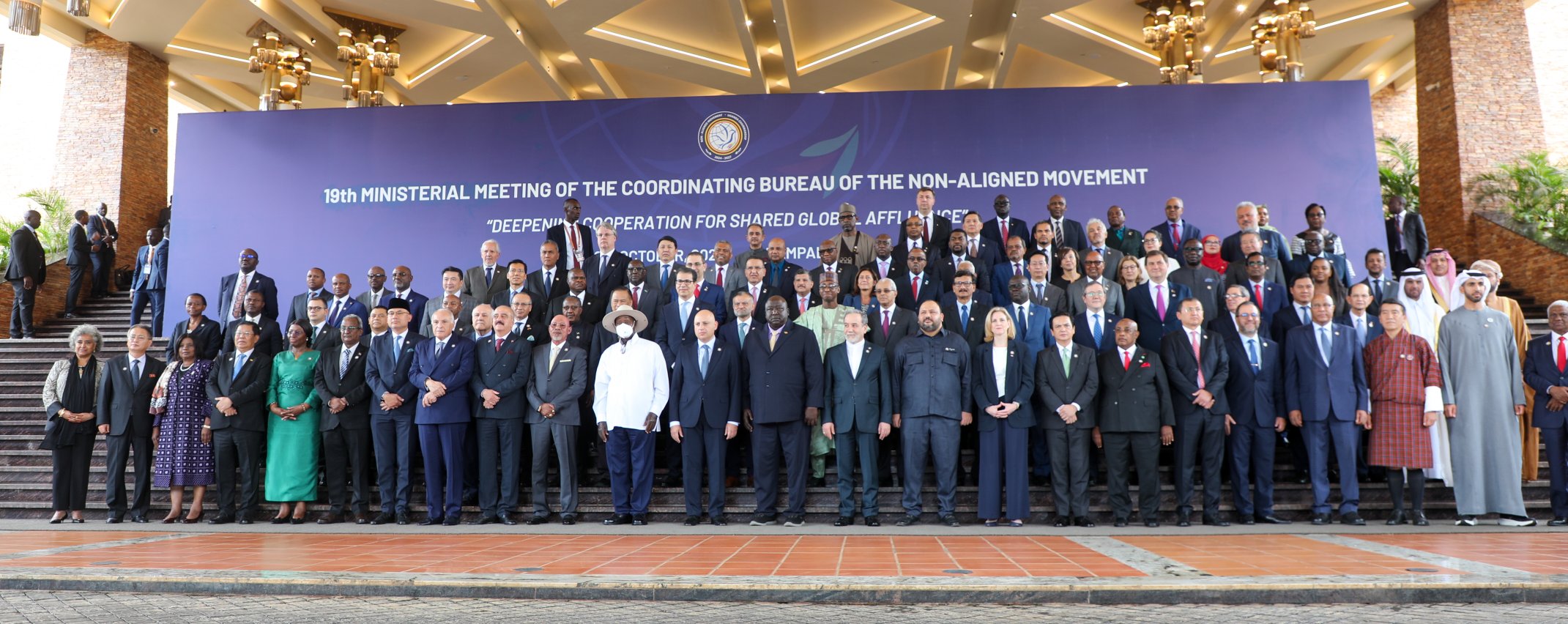
Kampala, Uganda — Ministers attending the Non-Aligned Movement (NAM) Ministerial Review Meeting in Kampala have reiterated the urgent need for a lasting solution to the Gaza conflict, following the recent ceasefire brokered by U.S. President Donald Trump.
Uganda’s Minister of State for Foreign Affairs, Hon. Henry Oryem Okello, told journalists that nearly all delegates emphasized the importance of sustaining the truce and moving toward a permanent peace framework that ensures the release of remaining hostages and long-term stability in the region.
“There was strong consensus that the ceasefire must hold and that the international community should focus on achieving sustainable peace,” Oryem said.
Delegates welcomed what many described as a critical but fragile breakthrough after a ceasefire and a large hostage-for-detainee exchange that culminated in the Sharm el-Sheikh (Sharm el-Sheikh) peace summit.
Delegates also called for NAM to take on a more prominent and assertive role in global affairs, noting that the current international order lacks proper direction and inclusivity. “Many speakers urged NAM to become more active and influential in shaping the global agenda,” Oryem added.
Environmental protection was another major theme, with small island states warning that without urgent climate action, they could disappear from the map within the next two decades.
The meeting also saw heated exchanges between delegations from the United Arab Emirates and Sudan over the interpretation of the Sudan ceasefire and the urgent need to establish a government of national unity in Khartoum.
The conflict is widely understood as a power struggle between the Sudanese Armed Forces (SAF) and the Rapid Support Forces (RSF), a paramilitary group whose contested integration into the regular army and whose political ambitions ignited violence after the 2021 coup and subsequent failed transition arrangements.

Countries such as Venezuela and Cuba strongly denounced U.S. sanctions and what they described as acts of intimidation and attempts to impose regime change. Havana, in particular, called for the immediate lifting of the illegal U.S. blocakde and its removal from the list of state sponsors of terrorism.
Foreign Minister Bruno Rodríguez Parrilla has publicly rejected the listing of Cuba as a “state sponsor of terrorism,” calling the designation politically motivated and harmful to ordinary Cubans by restricting banking, loans and humanitarian imports.
Venezuela’s case featured over U.S. pressure and the geopolitics of regime challenge. Venezuelan representatives framed U.S. measures as attempts to isolate and destabilize their government; critics in the meeting cautioned that coercive tools that bypass multilateral frameworks fuel regional polarization.
Overall, delegates expressed appreciation for the renewed energy and direction under Uganda’s chairmanship of NAM, with many commending President Yoweri Museveni for steering the Movement toward a more active role in addressing global challenges.