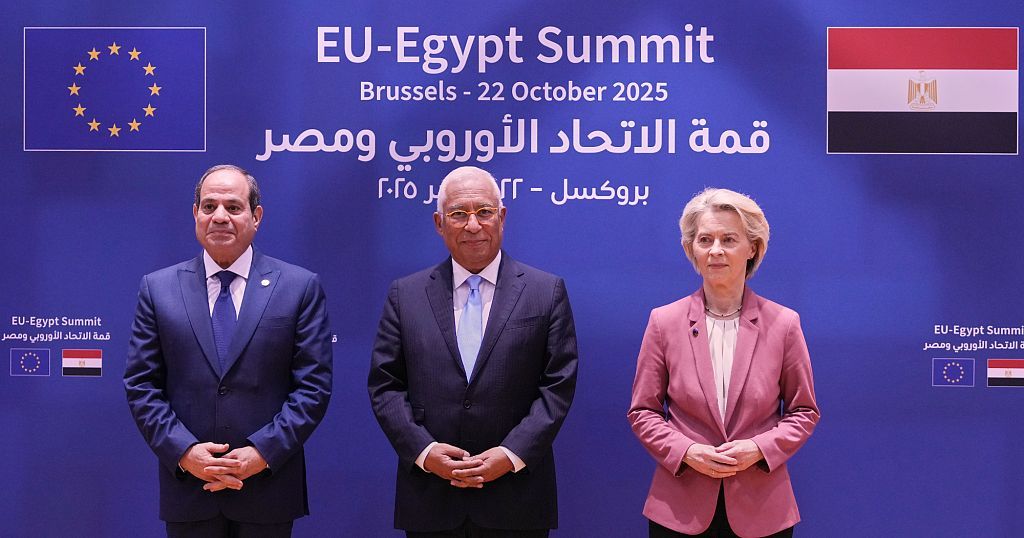
The Embassy of the Federal Democratic Republic of Ethiopia in Brussels has sharply criticized a recent “Joint Statement” issued by the European Union and Egypt on October 22, 2025, describing it as “problematic and deeply disappointing.” In a strongly worded press release, the Embassy accused the EU of echoing Egypt’s “colonial and monopolistic claims” over the Nile River, saying the statement disregarded the rights and interests of other riparian states.
According to the Embassy, the EU–Egypt declaration “shows a complete disregard for the views and interests of other riparian countries,” ignoring the fact that the Nile is shared by eleven nations and sustains nearly half a billion people across Sub-Saharan Africa.
“It is regrettable that the EU decided to undermine Ethiopia in a bilateral platform with Egypt,” the statement read. “The ‘Joint Statement’ propagates inaccurate, biased, and hostile positions against Ethiopia contrary to the quality of the historic relations that exist between Ethiopia and Europe.”
The Embassy further criticized the EU’s interpretation of international law, saying it contradicts existing global and regional water governance frameworks, including the Nile River Basin Cooperative Framework Agreement (CFA), the UNECE Water Convention, and the 1997 UN Convention on the Law of the Non-navigational Uses of International Watercourses.
Ethiopia emphasized that key principles of international water law — particularly “equitable and reasonable utilization” — were neglected in the EU’s position. It accused the bloc of compromising its own credibility as a defender of a rules-based international order.
“Given that the European continent has several transboundary water resources and basin-wide cooperation mechanisms, the EU’s distorted take on international law is deplorable,” the Embassy stated.
The statement also called out the EU for failing to adopt a balanced and impartial stance in its role as an observer in the African Union-led negotiations on the Grand Ethiopian Renaissance Dam (GERD). Addis Ababa stressed that the dam, officially named the Grand Ethiopian Renaissance Dam, symbolizes “self-reliance and Africa’s reawakening,” not a threat to downstream countries.
Concluding the statement, Ethiopia expressed readiness to engage with the EU and its member states to “rectify the gross and wrongful positions” contained in the joint communiqué with Egypt.
The diplomatic rift underscores renewed tensions over the management and use of the Nile waters, as Ethiopia continues to defend the GERD project — Africa’s largest hydroelectric dam — as a cornerstone of regional development and sovereignty.