
UNSG Race: Otunnu’s Opposition Votes Drop from 11 to 9 in 8th Straw Poll
November 5, 2026
Uganda’s candidate for United Nations Secretary-General, Ambassador Olara Otunnu, recorded a reduction in opposition votes in the eighth Security Council straw poll, while Costa Rica’s Rebeca Grynspan extended her lead in the race to succeed António Guterres.
The latest informal ballot, held on November 5, gave Otunnu four “encourage” votes, nine “discourage” votes and two “no opinion” votes, according to results circulated following the vote.
Although Otunnu maintained his four positive votes from the previous round, the number of Council members discouraging his candidacy fell from 11 in the seventh poll on October 30 to nine.
Grynspan received 12 “encourage” votes, three “discourage” votes and no “no opinion” votes, improving on her previous result of 11 encouragements and four discouragements.
Argentina’s Rafael Grossi received nine “encourage” votes, four “discourage” votes and two “no opinion” votes, while Guyana’s Carolyn Rodrigues-Birkett recorded eight, five and two, respectively.
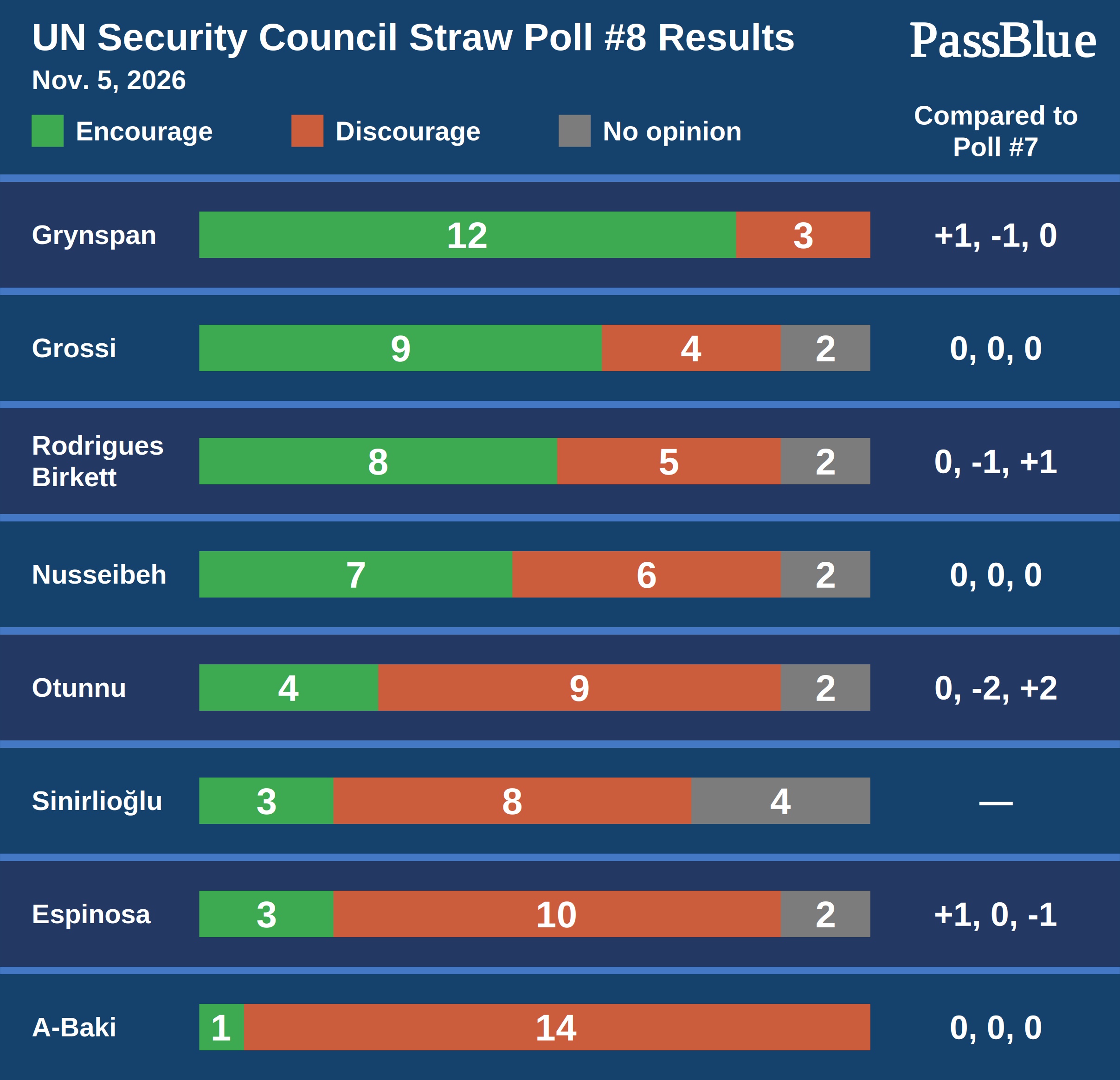
The UAE’s Lana Nusseibeh maintained her previous tally of seven encouragements, six discouragements and two no-opinion votes.
New Turkish candidate joins the contest
Türkiye’s candidate, Feridun Hadi Sinirlioğlu, participated in the eighth poll for the first time after his nomination on November 1.
Sinirlioğlu received three “encourage” votes, eight “discourage” votes and four “no opinion” votes.
His entry brings another diplomatic figure into a contest that has continued to feature varying levels of support among the Security Council’s 15 members.
Ecuador’s María Fernanda Espinosa received three encouragements, 10 discouragements and two no-opinion votes, while Ivonne A-Baki recorded one encouragement, 14 discouragements and no no-opinion votes.
What the latest figures mean for Otunnu
Otunnu’s latest result represents a reduction in discouragement votes, but his four encouragements remain unchanged from the previous round.
The Ugandan diplomat has built his campaign around consensus-building, institutional reform, human rights and the restoration of the UN’s moral authority.
His campaign recently released a profile titled “Consensus Builder & Innovative Leader,” highlighting his record in resolving diplomatic deadlocks, including his role in developing the Security Council straw-balloting method in 1981.
The eighth poll used undifferentiated ballots, meaning the results do not reveal how individual votes were distributed between the five permanent members of the Security Council and the 10 elected members. It is therefore not possible to determine from these figures alone whether Otunnu has gained support among the permanent five.
The permanent members — China, France, Russia, the United Kingdom and the United States — hold veto power over the Council’s formal recommendation for Secretary-General.
This poll's undifferentiated ballots do not identify which permanent members, if any, changed their positions on Otunnu.
Straw polls are informal and non-binding. Under Article 97 of the UN Charter, the Secretary-General is appointed by the General Assembly upon the recommendation of the Security Council.
The next Secretary-General will succeed Guterres, whose second term ends on December 31, 2026.