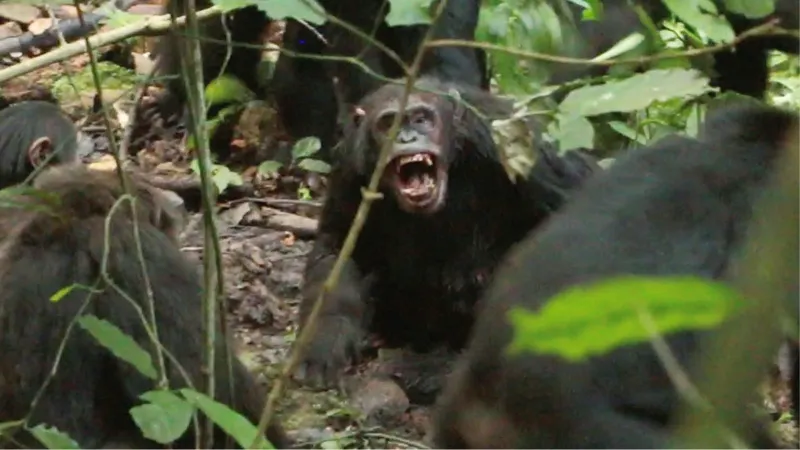
Deep within Kibale National Park, one of the most extraordinary and unsettling wildlife dramas is unfolding — a prolonged and deadly conflict among the world’s largest known community of wild chimpanzees.
What was once a tightly bonded group of nearly 200 chimpanzees at Ngogo has fractured into rival factions, unleashing a wave of violence that researchers now describe as a sustained “civil war.”
According to a new study published in Science, the conflict has raged for nearly eight years, leaving at least 24 chimpanzees dead — including 17 infants — in a series of coordinated and often lethal attacks.
“These were chimps that would hold hands,” said Aaron Sandel, lead author of the study and co-director of the Ngogo Chimpanzee Project. “Now they’re trying to kill each other.”
From Harmony to Hostility
For decades, the Ngogo chimpanzees lived in what scientists considered an unusually stable and cooperative mega-community. Though loosely organized into subgroups known as Western and Central, they coexisted peacefully — grooming, feeding, and patrolling together.
That cohesion began to unravel in 2015.
Researchers observed a dramatic shift: members of the Western subgroup fleeing and being chased by the Central group. While conflict among chimpanzees is not uncommon, such disputes typically end in reconciliation.
This time was different.
A six-week period of near-total separation followed. When encounters resumed, they were marked by heightened aggression. By 2018, the split had hardened into two distinct factions — and violence escalated into deadly, targeted attacks.
The Anatomy of a Breakdown
Scientists believe the conflict was not triggered by a single event, but rather a cascade of destabilizing factors:
- Social disruption (2014): The unexplained deaths of several key adult chimpanzees weakened long-standing social bonds
- Power shift (2015): A change in the alpha male altered the dominance hierarchy, increasing tension and fragmentation
- Disease outbreak (2017): A respiratory epidemic killed 25 chimpanzees, including individuals who had served as critical links between subgroups
- Population pressure: With numbers approaching 200, competition for food, territory, and mating opportunities intensified
Together, these shocks fractured trust within the community, transforming former allies into adversaries.
Violence Without Ideology
What makes the Ngogo conflict particularly significant is not just its brutality, but what it reveals.
Chimpanzees, among humanity’s closest genetic relatives, are engaging in organized, lethal violence — without the influence of religion, politics, or ideology.
“In the case of the Ngogo split, individuals who lived, fed, groomed and patrolled together for years became targets of lethal attacks based solely on their new group membership,” the researchers wrote.
The implication is stark: the roots of conflict may lie deeper than human constructs — embedded instead in social dynamics, identity, and group division.
A Mirror to Human Conflict
The findings are prompting renewed reflection among scientists studying the origins of human warfare.
James Brooks of the German Primate Center described the study as a powerful reminder of the dangers inherent in group fragmentation.
“Humans must learn from studying the group-based behaviour of other species,” he noted, “while remembering that their evolutionary past does not determine their future.”