Business
Uganda Pitches $500bn Economy Plan to Korean Investors

SEOUL, South Korea — Uganda has stepped up its drive to attract Korean capital and technology, presenting itself as a competitive manufacturing and investment base for the wider African market as the country pursues its ambition of building a $500 billion economy by 2040.
The pitch was made Tuesday at the Uganda–South Korea Trade and Investment Meeting at The Westin Seoul Parnas, held under the theme “Boosting Trade and Investment Between Uganda and South Korea.”
The meeting, co-hosted with the Korea International Trade Association (KITA), brought together Ugandan government officials, the Uganda Investment Authority (UIA), Korean government representatives and private-sector players.
Leading Uganda’s delegation, Second Deputy Prime Minister Dr Crispus Kiyonga said Uganda’s economy had expanded to about $70 billion, with real GDP growing by an average of more than 6 percent annually over the past decade.
He projected that economic growth could exceed 10 percent once commercial oil production begins later this year.
“Use Korean capital, use Korean technology, tap into Ugandan resources.”
That message from UIA Director of Investment Richard Nuweyesiga captured the central pitch to Korean companies: combine Korea’s technology and investment capacity with Uganda’s natural resources, youthful workforce and access to regional markets.

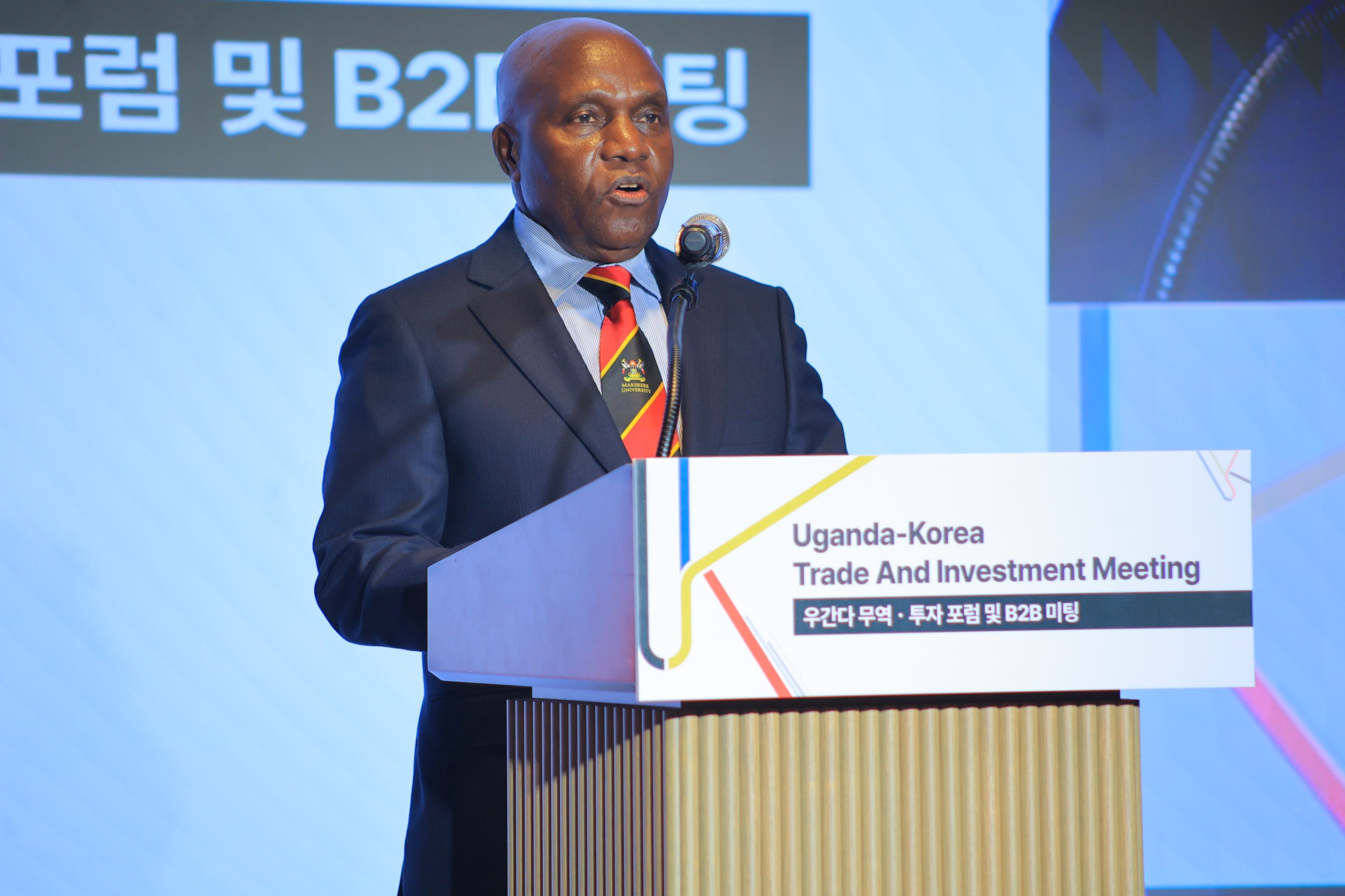
Second Deputy Prime Minister Dr Crispus Kiyonga
Uganda offers incentives to Korean investors
Dr Kiyonga highlighted what he described as Uganda’s investor-friendly environment, including business registration that can take as little as 45 minutes, a 10-year tax holiday, exemptions on imported machinery and access to land for strategic investments.
Investors operating in industrial parks can also benefit from a 10-year income tax exemption on rental income, while mining exploration equipment qualifies for full depreciation, he said.
Uganda is also positioning its geographical location as a major advantage.
Situated in East Africa, Uganda provides access to markets in the East African Community (EAC), COMESA and the African Continental Free Trade Area (AfCFTA).
Dr Kiyonga put the combined market opportunity at more than $3.1 trillion.
He also highlighted Uganda’s demographic advantage, noting that more than 73 percent of the population is below the age of 30 and that the country has a largely English-speaking workforce.
Coffee deal gives investment talks early boost
The Seoul meeting comes after Uganda secured a concrete commercial partnership with a Korean coffee company.
On Monday, Uganda signed a memorandum of understanding with GVCC Co. Ltd, a coffee company based in Busan.
Under the agreement, Besmark Coffee Company Ltd will serve as Uganda’s exclusive supplier while GVCC becomes the exclusive distributor in South Korea.
The first shipment — two containers of Ugandan coffee — is already being transported to South Korea.
The companies intend to use Busan as a regional hub for processing and re-exporting Ugandan coffee to other Asian markets, including Japan and Southeast Asia.
GVCC Chief Executive Soo-jung Lim said the company was ready to expand its trade relationship with Uganda after developing an interest in Ugandan coffee during an exhibition in Busan.
Uganda’s Ambassador to Japan, Tophace Kaahwa, whose mission is accredited to South Korea, said the Korean company was targeting volumes of about one 20-tonne container per day, equivalent to roughly 3,500 tonnes annually.
He called on Ugandan farmers to increase production to meet the emerging demand.
The coffee partnership illustrates the type of value-chain cooperation Uganda wants to attract — combining Ugandan agricultural production with Korean distribution networks, processing capacity and access to Asian markets.
Manufacturing opportunities
Uganda’s investment pitch extended beyond agriculture.
Richard Okot, Assistant Commissioner at the Ministry of Trade, Industry and Cooperatives, said Uganda’s central position could help Korean manufacturers reduce logistics costs when supplying markets in Kenya, Tanzania, the Democratic Republic of Congo, South Sudan and Rwanda.
He identified vehicle parts and filters, medical devices, diagnostic equipment and pharmaceuticals among products that could increasingly be manufactured locally through joint ventures.
Coffee and cocoa could similarly form cross-border value chains, with initial processing undertaken in Uganda before finished products are exported to South Korea.
Officials also presented opportunities in iron and steel processing, renewable energy and nuclear applications.
Commissioner for Nuclear Energy at the Ministry of Energy and Mineral Development, Eng. Simon Tebasulwa Kelanzi, invited Korean investment into iron and steel, wind and solar power and nuclear-related applications.
Uganda’s Ministry of ICT and National Guidance also pitched opportunities in software development, business-process outsourcing, artificial intelligence and other digital services.
Commissioner for Information Technology Amos Mpungu pointed to South Korea’s transformation from an agrarian economy into a global technology powerhouse as an example of what Uganda could pursue through technology partnerships.
Seoul signals interest in deeper economic ties
South Korea also signalled its desire to translate its long-standing diplomatic relationship with Uganda into stronger commercial ties.
Kwang-yong Chung, Director General for African and Middle East Affairs at South Korea’s Ministry of Foreign Affairs, said Africa was emerging as an increasingly important engine of global economic growth.
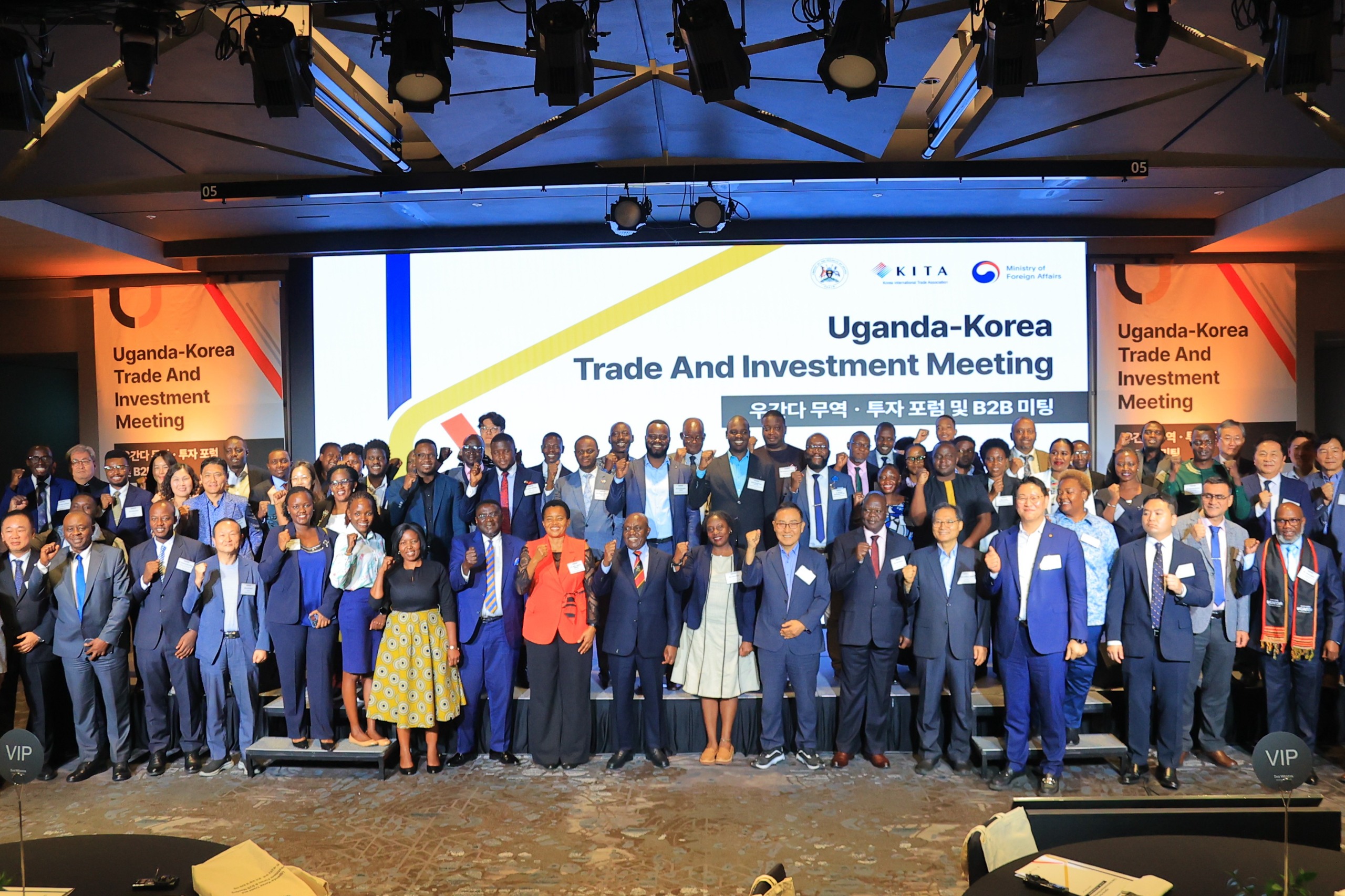
He said Seoul wanted to build on its government-to-government relationship with African countries by expanding trade and investment.
South Korea hosted the inaugural Korea–Africa Summit in 2024 and plans to hold the next summit in 2029, with discussions underway on making the gathering a regular platform.
Korean development cooperation in Uganda has already supported sectors including education, health and infrastructure.
Dr Kiyonga said South Korea’s development assistance to Uganda had surpassed $500 million since the two countries established diplomatic relations in 1963.
From aid to investment
For Uganda, the Seoul meeting represents an effort to deepen the relationship beyond development assistance and toward commercial partnerships, manufacturing and technology transfer.
The investment discussions also included a matchmaking programme linking six Ugandan companies with Korean businesses in electronics, biotechnology and financial technology.
The engagements follow a diaspora outreach programme in Seoul over the weekend, during which Ugandan officials encouraged Ugandans living in South Korea to invest their capital, expertise and skills back home.
Ugandans in South Korea also renewed calls for a resident Ugandan diplomatic mission in Seoul. Uganda currently handles consular services from its embassy in Tokyo, with the ambassador accredited to South Korea on a non-resident basis.
The Uganda–South Korea investment programme continues through 10 September, with sector-specific meetings and further business-to-business engagements expected.
For Kampala, the objective is increasingly clear: convert Uganda’s resources and market access into industrial capacity, while using Korean capital and technology to accelerate the country’s transformation toward its $500 billion economy target by 2040.