News
From Fifth to Third: Otunnu Gains Ground in UN Secretary-General Race After 3rd Straw Poll

UNITED NATIONS, September 18, 2026 — Uganda’s candidate for United Nations Secretary-General, Ambassador Olara Otunnu, has climbed from fifth to third place in the latest Security Council straw poll, strengthening his position in the increasingly competitive race to succeed António Guterres.
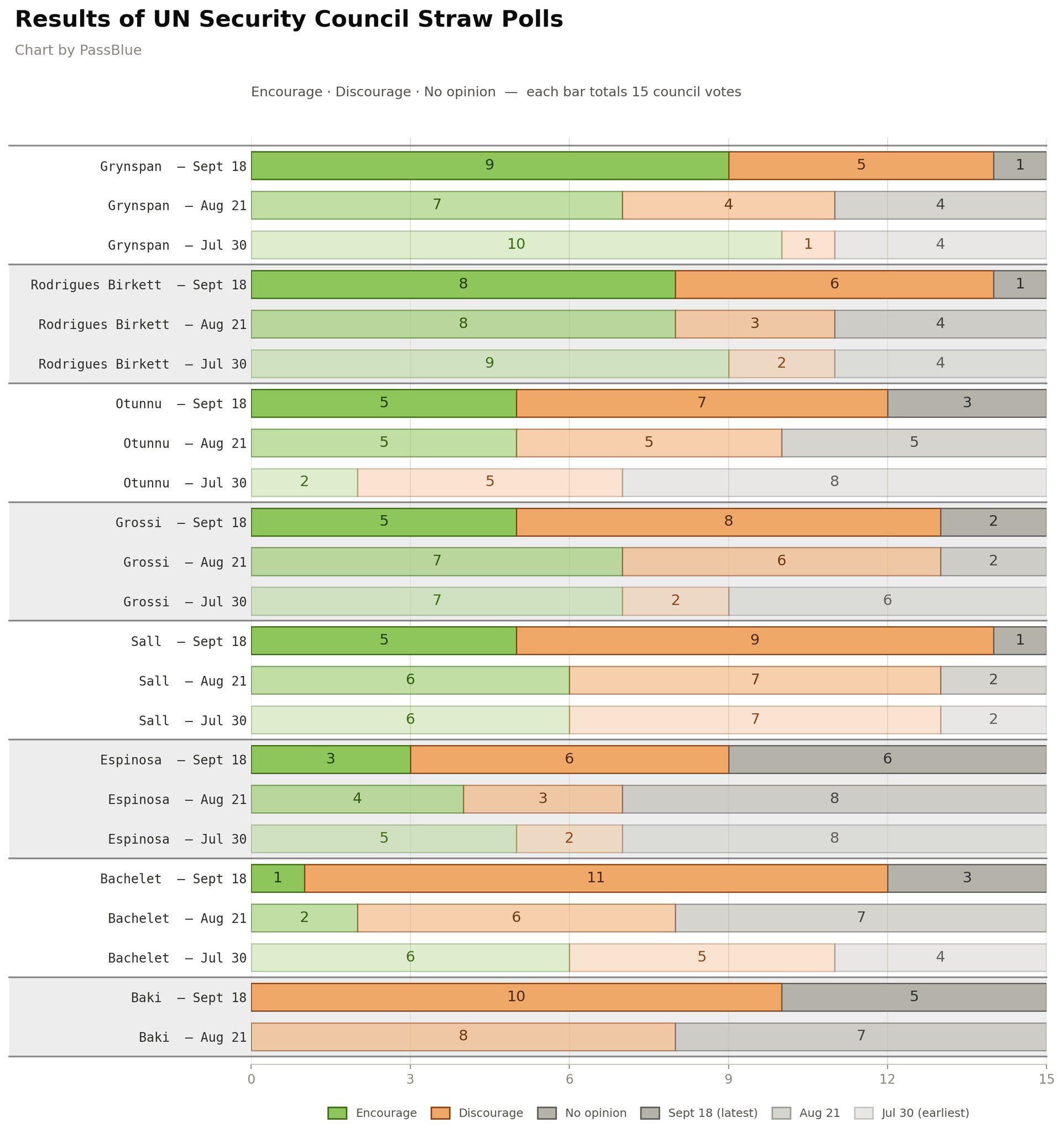
Otunnu secured five “encourage” votes, seven “discourage” votes and three “no opinion” votes in the third informal poll conducted by the 15-member Security Council on Friday, according to results circulated following the confidential vote.
The result marks a change in Otunnu’s position from the second straw poll on August 21, when he also received five “encourage” votes but had five “discourage” votes and five “no opinion” votes.
In the second round, Otunnu was fifth by the distribution of support. In the latest poll, he moved into third place, behind Costa Rica’s Rebeca Grynspan and Guyana’s Carolyn Rodrigues-Birkett.


Grynspan recorded nine “encourage” votes, five “discourage” and one “no opinion”, while Rodrigues-Birkett received eight “encourage”, six “discourage” and one “no opinion”.
Otunnu’s five “encourage” votes put him level with Argentina’s Rafael Grossi and Senegal’s Macky Sall, who also received five each. However, Otunnu recorded fewer “discourage” votes than both candidates — seven compared with eight for Grossi and nine for Sall — placing him ahead of them in the latest ranking.

Otunnu’s steady support base
The latest poll shows that Otunnu has maintained the five “encourage” votes he secured in August, while his “no opinion” votes fell from five to three.
His “discourage” votes, however, increased from five to seven.
The movement is notable because the straw polls are intended to give Security Council members an indication of the relative viability of candidates before the Council moves towards a formal recommendation.
In the first poll on July 30, Otunnu received just two “encourage” votes, five “discourage” votes and eight “no opinion” votes.
His progression across the three polls is therefore:
July 30: 2 encourage | 5 discourage | 8 no opinion
August 21: 5 encourage | 5 discourage | 5 no opinion
September 18: 5 encourage | 7 discourage | 3 no opinion
The figures show that the number of Council members expressing an explicit position on Otunnu has increased over successive rounds.
Grynspan returns to top
The latest poll also saw Grynspan regain the top position after Rodrigues-Birkett led the second round.
Grynspan moved from seven “encourage” votes in August to nine in the latest poll, while Rodrigues-Birkett remained on eight.
Grossi, who had been third in the first two rounds, dropped behind Otunnu in the latest distribution, recording five “encourage”, eight “discourage” and two “no opinion” votes. Sall also received five “encourage” votes but nine “discourage” votes.
The remaining candidates recorded three or fewer “encourage” votes.
Michelle Bachelet received one “encourage”, 11 “discourage” and three “no opinion”; María Fernanda Espinosa received three “encourage”, six “discourage” and six “no opinion”; while Ivonne Baki received no “encourage” votes, 10 “discourage” and five “no opinion”.
Race remains open
Despite Otunnu’s movement into third place, no candidate has yet secured the nine positive votes needed to demonstrate sufficient Security Council support.
The latest results also show that the field remains unsettled. The two leading candidates have not yet reached the threshold, while Otunnu’s five positive votes leave him several votes short of the level required for a Security Council recommendation.
The eventual recommendation must receive at least nine votes in the 15-member Council and must not be blocked by any of the five permanent members — China, France, Russia, the United Kingdom and the United States.
The Council then recommends one candidate to the 193-member General Assembly for appointment.
The third poll was held as world leaders prepare to gather in New York for the high-level week of the General Assembly.
Moscow engagement gains context
Otunnu’s improved position comes days after he travelled to Moscow, where he met Russian Foreign Minister Sergey Lavrov.
He was accompanied by former Prime Minister Dr Ruhakana Rugunda, who is coordinating Uganda’s campaign for his candidature.
The Moscow engagement was part of Uganda’s outreach to members of the Security Council, particularly the five permanent members whose positions will ultimately be critical to the selection process.
Otunnu has also used his campaign to outline a reform-oriented vision for the UN, calling for a more inclusive organisation and one that moves beyond what he has described as a “diplomatic ivory tower” centred on New York, Geneva and Vienna.
Speaking to BBC Radio, he said he wants a UN “not of power and privilege, but the UN of service and impact.”
He has also placed conflict resolution, including the wars in Gaza and Ukraine and conflicts in Africa, at the centre of his campaign agenda.
From fifth to third
For Uganda, the latest straw poll provides a new marker in Otunnu’s campaign.
While his number of “encourage” votes has remained unchanged from the second poll, his relative position has improved from fifth to third as the distribution of support and opposition among the candidates has shifted.
The next stage will be whether Otunnu can convert his current five positive votes into broader support as the Security Council continues its consultations.
In the 2016 selection process, six straw polls were conducted before the Council reached agreement on António Guterres. The current process has now completed three rounds, with eight candidates still in contention.