Business
From a Katwe Storefront to a Regional Supply Chain: The Decade-Long Rise of Happy Home Enterprises

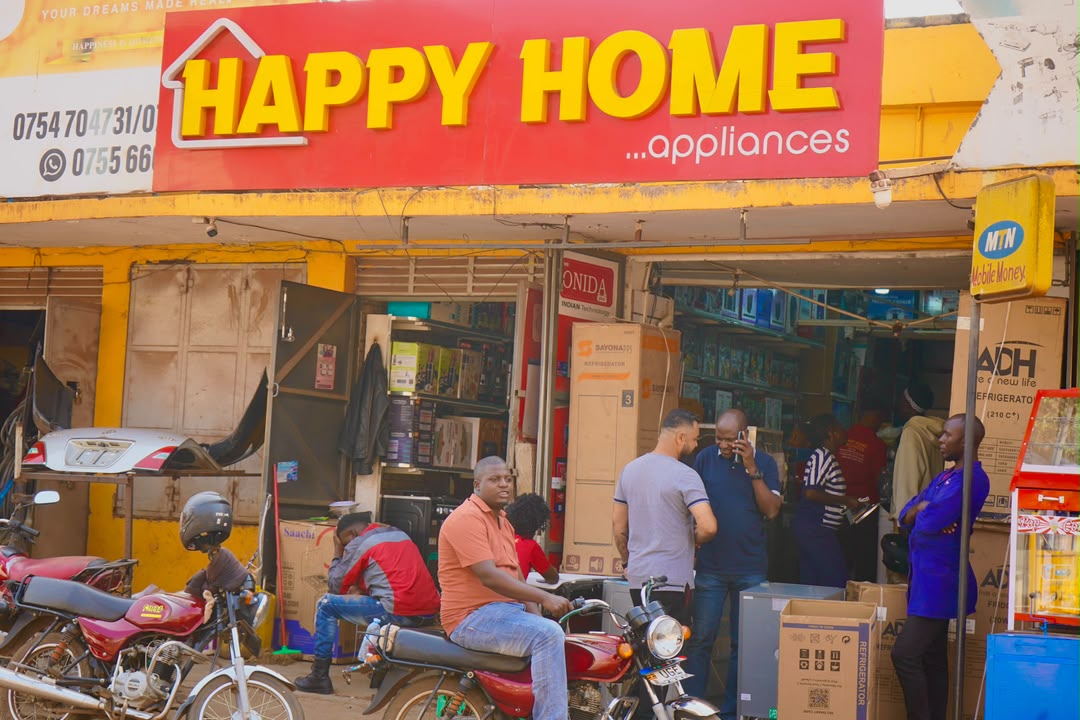
Kampala, Uganda — On a narrow stretch of road in Katwe, one of Kampala’s oldest and most congested commercial districts, rows of appliance shops compete for the same passing foot traffic, the same price-sensitive customers, and the same suppliers. It is a market defined by thin margins and short memories, where a business can open with fanfare and vanish within a year. Against that backdrop, a company that started as a single appliance outlet nearly a decade ago has grown into a name that now appears on delivery manifests as far away as Juba, Addis Ababa, Bujumbura and Accra.
Happy Home Enterprises, which trades locally and regionally as Happy Home Appliances Uganda, was registered in October 2016 by entrepreneur Kiyegga Simon Peter. Happy Home Appliances Uganda posts as @happy_home_enterprises on TikTok where it showcases refrigerators, washing machines, smart televisions and commercial equipment to a growing regional audience. What began as a modest household appliance shop opposite MK Plaza in Katwe has, over the course of roughly a decade, evolved into a supplier of refrigerators, washing machines, smart televisions, kitchen equipment and commercial machinery to households, hotels, hospitals, churches, government agencies and private businesses across East Africa and beyond.
A Shop Among Thousands
Katwe is not an obvious launchpad for a regional distribution business. The area, a few minutes’ drive from Kampala’s central business district, is known for its density of small traders selling everything from spare parts and furniture to electronics and secondhand clothing. Competition is immediate and visible — rival shops often sit within a few doors of each other, and price undercutting is common.
When Kiyegga opened the shop, his ambition was to be known for reliability, affordability and consistent after-sales service, in a segment of retail where customer support has often been informal or absent once a sale is completed. The objective was building a brand Ugandans could trust for both household and business equipment, rather than a shop competing purely on shelf price.
What followed was a gradual process: the company built a customer base through word of mouth and repeat purchases before pursuing bigger institutional contracts or geographic expansion, rather than the reverse. Steady, referral-driven growth in the early years brought larger clients later as the business demonstrated it could deliver consistently on warranty and service commitments.
What the Company Sells — and to Whom
Happy Home Enterprises’ product catalogue spans both domestic and commercial categories. On the household side, it supplies refrigerators, washing machines, smart televisions, blenders, kettles and other kitchen appliances. On the commercial side, its range includes deep freezers, commercial blenders, popcorn machines and other equipment used by small food and hospitality businesses.
That dual focus matters in a market like Uganda’s, where a large share of economic activity happens through informal and semi-formal small businesses. This segment of Happy Home’s client base includes food vendors, laundromats and small manufacturing operations concentrated in and around Katwe.
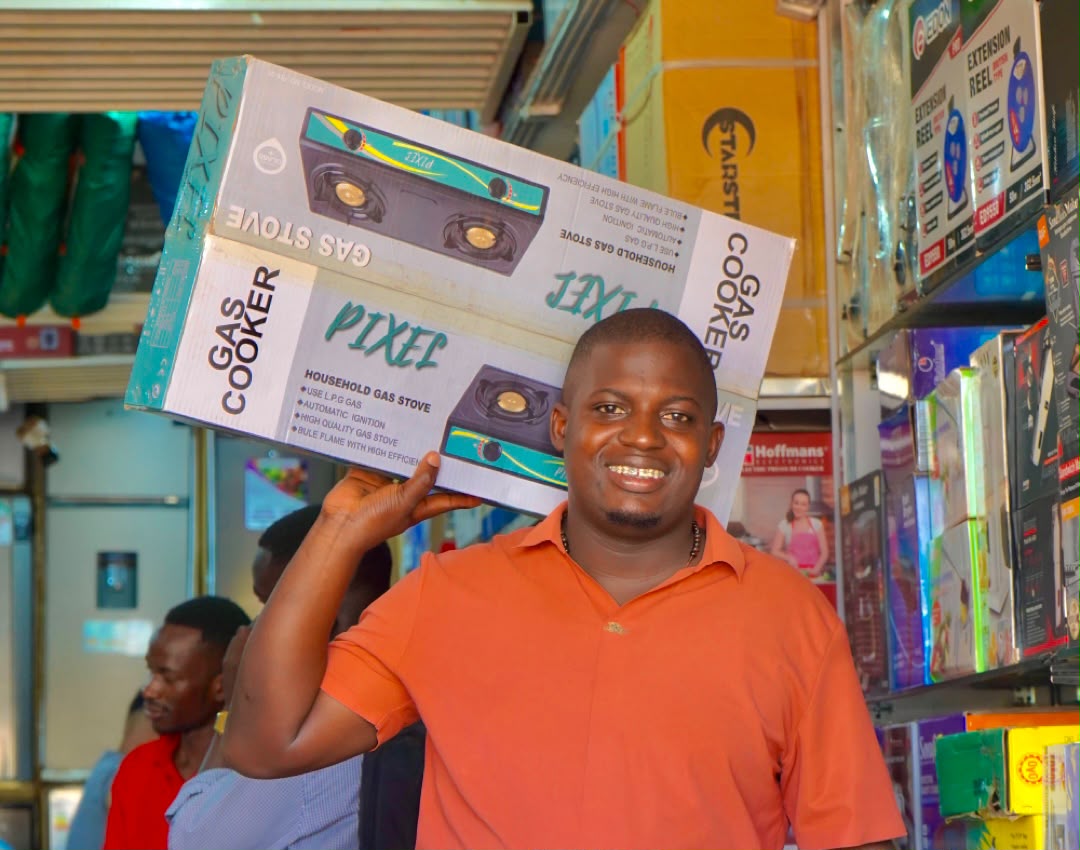

The company has also built a client list that extends into more formal institutional territory. Happy Home has supplied equipment to Uganda’s National Water and Sewerage Corporation (NWSC), a state utility whose procurement processes require documented quality assurance and formal invoicing. The company also reports supply relationships with hospitals, religious institutions and community-based organisations, where equipment reliability and maintenance turnaround affect service delivery.
Crossing Borders
The most distinctive element of Happy Home’s growth is its expansion beyond Uganda’s borders. The company now supplies customers in South Sudan, Ethiopia, Burundi and Ghana, in addition to its home market. For a business that started as a single shopfront in Katwe, that represents a meaningful logistical leap — cross-border trade requires functioning supply chains, freight arrangements, customs handling and the ability to manage inventory across jurisdictions with different currencies and regulatory regimes.
The expansion required deliberate investment in logistics and supply-chain management rather than an organic overflow of domestic demand. Operating in several countries has required greater operational discipline — from inventory management to delivery systems capable of meeting different customer expectations in different markets.
Uganda’s landlocked geography means that regional trade — particularly with South Sudan, a market with which Uganda has long-standing commercial ties — has been an important channel for Ugandan manufacturers and retailers seeking growth beyond the domestic market. A Ugandan appliance retailer building supply relationships in South Sudan, Ethiopia, Burundi and Ghana is participating in a wider pattern of Ugandan traders using regional networks to grow.
Digital Retail and the TikTok Presence
If Happy Home’s institutional and cross-border business represents its conventional growth story, its social media presence represents the more visible one. Its TikTok account @happy_home_enterprises is central to how it markets appliances, announces promotions and interacts with customers. The account has accumulated a substantial following and engagement, and the company uses short-form video to demonstrate products such as blenders, kettles, deep freezers and smart televisions in a format that is more entertaining and informal than conventional retail advertising.
The company has collaborated with several Ugandan digital creators and public figures as part of its marketing approach, extending the brand’s reach to audiences beyond those who might encounter it through the physical shop in Katwe. Its customer engagement model is built around direct interaction: responding to comments on video posts, and converting inquiries generated through social media into calls or WhatsApp messages that lead to a sale, either in-store or through direct delivery.
This social-commerce approach mirrors a wider shift across Uganda’s retail sector, where a young and increasingly online population has made platforms like TikTok, Instagram and WhatsApp meaningful sales channels for businesses.
Community Ties and Sponsorship
Beyond its commercial activity, Happy Home Enterprises has built a public profile through sponsorship and community engagement. The company has partnered with sporting organisations, including Kampala Capital City Authority Football Club (KCCA FC) and the Mapeera League, a grassroots football competition. Sponsorship arrangements of this kind are common among Ugandan retail and consumer brands seeking visibility among younger audiences who follow local football closely.
The company has also taken part in charitable activities intended to support vulnerable communities, combining commercial growth with corporate social responsibility. As a growing retail enterprise, it creates jobs across sales, marketing, logistics, technical support and administration.
The Economics of Selling Imported Appliances in Uganda
Like most players in the sector, Happy Home depends on imported products, which leaves it exposed to currency fluctuations, shipping costs and disruptions in global supply chains — all factors that can move pricing and profit margins in ways a retailer cannot fully control.
Uganda imports the overwhelming majority of its household and commercial appliances, mainly from Asian and Middle Eastern manufacturing hubs, and the shilling’s periodic depreciation against the US dollar has historically squeezed margins across the entire electronics and appliance retail sector. The response has been to diversify its product range across different price categories, so that budget-conscious households and small businesses can still find something within reach, while wealthier customers and larger institutions are served through higher-specification products.
A Story of Incremental Growth
One of the more consistent threads in the company’s trajectory is an emphasis on gradual, self-funded growth rather than a single transformative event. The trajectory is one of gradual reinvestment and operational growth rather than expansion driven by large external investors, with each stage — from serving individual households in Katwe to supplying institutions and then regional markets — requiring new internal systems for inventory, logistics and customer service.
That framing situates Happy Home within a broader pattern often observed among Uganda’s more durable small and medium enterprises, which tend to scale by proving out capacity in one segment before entering the next, rather than expanding across multiple fronts simultaneously.
Placing Happy Home Within Uganda’s Wider Retail Sector
Formal, large-format retail chains remain relatively rare outside Kampala’s more affluent shopping malls, and much of the country’s household and commercial equipment still changes hands through small, independently owned shops clustered in trading areas like Katwe, Kikuubo and Nakivubo.
In that context, a retailer that can consistently supply working, warrantied equipment — rather than the used or reconditioned appliances that circulate widely in lower-income segments — occupies a genuinely useful niche. By equipping small food vendors, salons and service businesses with functioning appliances, retailers of this kind indirectly support the survival and growth of smaller enterprises that rely on them.

Looking Ahead
As Happy Home Enterprises approaches the tenth anniversary of its founding, the company is positioning itself for two parallel trends. The first is the growing consumer and institutional appetite across East Africa for energy-efficient and smart appliances. The second is the continued maturation of digital and social commerce in Uganda, a market where mobile money penetration and smartphone use have grown rapidly over the past decade.
Whether the company can sustain its current growth trajectory will likely depend on factors largely outside its control — the trajectory of the Ugandan shilling, the cost and availability of freight, and the broader health of consumer and institutional spending across the markets it now serves. What the last decade suggests is a business that has grown by solving one operational problem at a time — building trust in a single shop, then formal client relationships, then cross-border logistics, then a digital customer base.
For a company that started opposite MK Plaza in Katwe with a modest stock of household appliances, that incremental approach appears, so far, to have been enough to carry it into markets well beyond the street where it began.