
Egypt Asks Museveni To Mediate Nile Basin Pressing Issues
November 2, 2024
President Yoweri Kaguta Museveni has accepted an invitation from his Egyptian counterpart, His Excellency, Abdel Fattah El-Sisi to attend the Nile Basin States Summit in Cairo next year.
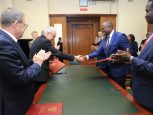
The Egyptian President’s invitation was formally delivered by Dr. Badr Abdelatty, Egypt's Minister of Foreign Affairs, Emigration, and Egyptian Expatriates, whom President Museveni received today at State House, Entebbe.
This summit, as the highest decision-making body of the Nile Basin Initiative, is seen as crucial for addressing political issues and coordinating the effective management of the basin's water resources.
The gathering will bring together 11 Heads of State from the Nile Basin countries, including Egypt, Ethiopia, Sudan, South Sudan, Kenya, Rwanda, Uganda, Eritrea, Tanzania, Burundi, and the Democratic Republic of Congo.
During the meeting, President Museveni underscored his perspective on the region's core issues and also emphasised his commitment to attending the Nile Basin States summit for a meaningful dialogue on securing the future of the Nile Basin through regional cooperation and sustainable development.
“The problem is not water; the problem is just ideology. I don’t know why we don’t agree, that's why I want a summit,” he said.
President Museveni also highlighted that unsustainable agricultural practices are contributing to environmental degradation in the tropics.
“If you maintain primitive agriculture in the tropics, people misuse the land and water bodies because they don’t know what to do. This leads to the invasion of wetlands and the destabilisation of rain systems,” he noted.
He further emphasised the need for socio-economic transformation in tropical countries to alleviate dependence on agriculture.
“The tropics must undergo social and economic transformation so that the population shifts from agriculture to industry and services, leaving a few people in agriculture who know what to do and don’t invade wetlands, forests, and catchment areas. These mountains, like Mt. Rwenzori, Mt. Kenya, and Mt. Elgon are water towers," he noted, pointing out that they sustain rainfall systems.
Recalling data from 1964, President Museveni highlighted a significant reduction in water flow from Uganda to South Sudan, which has decreased from 60 billion cubic metres to 40 billion cubic metres due to reduced rainfall.
“If you care about the Nile, make sure the tropics modernise, society shouldn’t rely on primitive agriculture but rather on services and industry," he urged.
President Museveni pointed to a larger global perspective, noting that 60% of Uganda's rain comes from the Pacific and Indian Oceans, while 40% is from local sources.
“If these local sources disappear, the 40% will vanish,” he warned.
President Museveni compared the Nile's 85 billion cubic metres of water in Khartoum to the Congo River's vast 3,000 billion cubic metres.
“The Congo River has the capacity of 30 Niles, if there was peace in Congo and collaboration among Nile Valley countries, we could work together to divert water to meet needs across Africa,” he said.
President Museveni also identified biomass dependency as another threat to the Nile Basin.
“The danger to the Nile comes from the population relying on biomass for cooking. We must protect the Nile from two dangers—primitive agriculture and lack of electricity. If we continue to destroy biomass, the impact will be severe,” he said.
On his part, Dr. Badr conveyed President El-Sisi’s message, noting that, “President El-Sisi will be delighted to receive you in Cairo. It’s timely to have this engagement to strengthen our collaboration.”
He praised Uganda’s leadership, emphasising Egypt’s reliance on President Museveni’s wisdom in guiding the Nile Basin Initiative forward.
Dr. Badr addressed Egypt’s heavy investment in water recycling to meet its national water needs.
“Without the Nile, we wouldn’t have the civilization we have. Our annual Nile water inflow is 55.5 billion cubic metres, but our consumption is 90 billion cubic metres. To bridge this 40% deficit, we recycle water four times and have invested over $15 billion to sustain this,” he remarked.
Turning to regional challenges, Dr. Badr expressed confidence in Uganda’s leadership to mediate on pressing Nile water issues.
“We trust in your leadership to bring consensus among Nile Basin countries and help us address challenges, including concerns about upstream projects,” Dr. Badr said.
“Your leadership in fostering understanding among Nile Basin countries is invaluable to us,” he added.
He mentioned that Egypt remains eager to expand bilateral relations with Uganda across various sectors, including infrastructure, food processing and pharmaceuticals.
“We have around 20 Egyptian companies already investing in Uganda, but our private sector is keen to do much more. The sky is the limit,” he noted.
Dr. Abdelatty also outlined Egypt’s intent to establish a joint ministerial committee to streamline collaboration on mutual interests.
“We hope to receive ministers of Water and Foreign Affairs from both countries to discuss specific projects on the ground that align with Uganda and Egypt’s shared goals,” he said.
“Egypt’s Cabinet has approved a new cooperation mechanism with our brothers and sisters in the Nile Basin region and we have established an agency to provide export and investment guarantees to encourage our business community, particularly small and medium enterprises to invest in Uganda."
In a promising development, he noted that Egypt has earmarked $600 million in export and investment guarantees for the Nile Basin region, with a particular focus on Uganda and other Equatorial Nile Basin countries.
“Additionally, a new financial mechanism funded by the Egyptian government, with an initial $100 million as seed money, will enable infrastructure and water projects across the region. This mechanism will be a game-changer, allowing us to advance developmental projects, clean waterways, and ensure sustainable development across the basin,” Dr. Badr explained.
Highlighting the importance of local manufacturing, Dr. Abdelatty shared Egypt’s interest in supporting Uganda's pharmaceutical sector.
“We are very keen to work with Uganda in the pharmaceutical industry, localising production for human and livestock use here,” he stated.
“Egypt has previously provided $10 million in vaccines and is eager to partner in manufacturing within Uganda to establish it as a regional health hub for East Africa."
The Egyptian Foreign Affairs Minister also highlighted that Egypt envisions collaboration on renewable energy and power generation.
“We already have a 4-megawatt power station in Uganda and are more than willing to expand this partnership, particularly in solar power,” Dr. Badr said.
The meeting was also attended by Hon. Henry Okello Oryem, the Minister of State for Foreign Affairs and the Egyptian delegation.



UG Diplomat is an independent digital news and media platform dedicated to comprehensive coverage of national politics, regional diplomacy, international relations, geopolitics, defense, and business. Published under Currentarc Media Ltd, we provide authoritative analysis, breaking news, and in-depth reporting on the diplomatic and economic developments shaping East Africa and the global arena.
COMPANY
Contact Us
Privacy Policy
Terms and Conditions
CONTACT INFORMATION
info@ugdiplomat.com
+256774552385
Copyright © 2026 UG Diplomat -Product of CURRENTARC MEDIA