News
Remembering Luwum: Museveni Calls for Leadership Through Service, Not Force


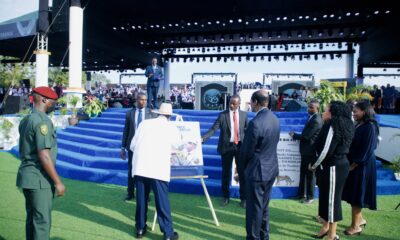
President Yoweri Museveni and First Lady Janet Museveni on Monday joined Christians in Wii-Gweng, Mucwini in Kitgum District to commemorate 49 years since the martyrdom of Janani Luwum, the former Archbishop of the Church of Uganda who was killed in 1977.
Addressing the gathering, President Museveni reflected on the leadership failures of former Ugandan ruler Idi Amin, saying his “mistake was ruling by force and killings.” He emphasized that sustainable leadership must be grounded in persuasion, service delivery, and good works rather than intimidation.
Museveni noted that the National Resistance Movement (NRM) has consistently championed what he described as “persuasion through action.” He cited infrastructure and social service improvements in Northern Uganda; including rural electrification, the construction and upgrading of health centres, and expansion of the road network, as examples of the government’s long-term commitment to the region.

COU Archbishop Emeritus Luke Orombi (L) speaks as Archbishop Steven Mugalu Kaziimba looks on
“Even when support in Northern Uganda was low, we extended electricity, built and upgraded health centres, and improved the road network. In the end, our people said: ‘NRM maber,’” the President said, expressing gratitude for what he called overwhelming support in the recently concluded elections.
The President also pledged to construct a befitting memorial in honour of Archbishop Luwum and to decisively address the challenge of cattle rustling in East Acholi.
Why Janani Luwum’s Legacy Still Shapes Uganda Today
Uganda marks Janani Luwum Day each year to honour the life, faith, and sacrifice of Janani Luwum, who was killed on February 16, 1977, during the regime of Idi Amin.
Why the Day Is Observed
Janani Luwum, then Archbishop of the Church of Uganda, Rwanda, Burundi and Boga-Zaire, became one of the most prominent religious voices to openly criticize human rights abuses, arbitrary arrests, and extrajudicial killings under Amin’s government. In early 1977, Luwum and other church leaders formally protested against state violence and the disappearance of Ugandans.


Shortly afterwards, he was arrested, publicly accused of treason, and later killed under controversial circumstances. The government at the time claimed he died in a car crash, but many accounts and later investigations indicated he was executed.
His death shocked the nation and drew widespread international condemnation. Over time, Luwum came to be regarded not only as a church martyr but also as a national symbol of courage, moral leadership, and resistance to tyranny.
National Recognition
In recognition of his sacrifice, the Government of Uganda declared February 16 a public holiday in 2015. Since then, Janani Luwum Day has been observed annually with national prayers and commemorations, often held at Wii-Gweng in Mucwini, Kitgum District, his birthplace.

The day serves both as a religious remembrance and a national reflection on leadership, justice, human rights, and the role of faith in public life. It also reinforces the broader historical lesson of Uganda’s turbulent past and the importance of constitutional governance and rule of law.
Today, Janani Luwum is remembered across denominations and internationally within the Anglican Communion as a martyr for faith and justice.