News
Mao on Speaker Among Job: “Ugandans See Oulanyah in Me”


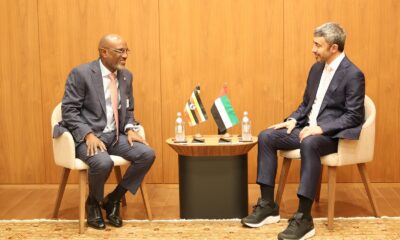
A post long considered internally settled within the ruling NRM party is quietly back in play after Justice Minister Norbert Mao ‘declared’ interest in the Speakership.
Speaking at the Democratic Party headquarters in Kampala on Tuesday, Mao refrained from a formal declaration, yet his statements are enough to shift the political conversation.
For the first time, a senior NRM–DP leader has openly treated the Speakership as an open contest, challenging the long-standing convention of CEC-backed continuity.
“When I was declared a Member of Parliament–elect, I started getting calls from many elected Members of Parliament urging me to contest for the position of Speaker. So what does an intelligent person do? The NRM has the majority of Members of Parliament, and it is only natural that the majority party should provide the Speaker,” Mao said.
He added that he is ready to meet President Museveni over the matter as he makes consultations across the political divide.
“Right now, I am carrying out consultations about that prospect. We shall also meet the leadership of the NRM, including the President, and talk openly about it. After all, everything we are doing is for Uganda. You are a Speaker of Uganda; you are not a Speaker for yourself,” he said.
While the NRM has historically ring-fenced the positions of Speaker and Deputy Speaker for continuity, often renewing incumbents without contest, Mao’s entry into the conversation introduces a cross-party dimension anchored in parliamentary legitimacy rather than party ownership.
Last week, it was reported that the NRM Central Executive Committee (CEC) sat and endorsed Anita Among and Thomas Tayebwa to continue as speaker and deputy.

However, Mao has grounded his case in constitutional language, emphasising that the Speaker “belongs to Parliament, not to a party,” a subtle but pointed reframing at a time when Parliament’s independence has increasingly come under scrutiny.
“A day is a very long time in politics. Today is February 3rd; elections are in May. Nobody should take anything for granted. including myself. I cannot claim anything, except that we must put the national interest first and must not tear the country apart because of a position,” Mao asserted.
His acknowledgement of the NRM’s numerical dominance suggests political realism rather than confrontation. Sources within Parliament note that Mao’s consultations with NRM leadership are less about defiance and more about testing elite consensus, particularly within State House-aligned parliamentary blocs.
Mao’s argument also leans heavily on his political utility to the NRM, especially in northern Uganda. His claim of sharply increased support for President Museveni in Gulu is likely aimed at reinforcing his value as a coalition asset rather than a DP dissident.
However, the move is not without risk. Within the Democratic Party, Mao’s ambitions revive internal tensions over the 2022 cooperation agreement, while within the NRM, any deviation from CEC-backed continuity could expose latent factional divides ahead of the 2026 electoral cycle.
Among was elected speaker following the death of Jacob Oulanyah who had spent under a year as speaker in the 2021 general elections. Mao revealed that as someone who was close to Oulanyah, he reminds Ugandans and the fallen speaker’s fans of his ideals.
“There is a hunger in the country for a more accountable Parliament. Whether I can fulfil that hunger is another matter, but that thirst exists. Citizens want a people’s House. People remember the unfinished term of the late Jacob Oulanyah, who happened to be my very close friend,” Mao said.
He added, “Somehow, I am the nearest to him. I am the one who reminds people of him the most. I am not him and I never will be, but sometimes one person reminds people of another.”
Mao’s declaration has sparked debate about the possibility of the ruling NRM Party, considering a member of the opposition to officiate the house where they are majority. His political settlement with government, gives him good ground to bargain.
By invoking the memory of Oulanyah, Mao has tapped into a public yearning that complicates the politics of continuity, considering many believe he had unfinished business. It waits to be seen whether Mao will use that to convince the powers that be.